The Long Read · Articulate
![A meme card held against a fog-bound Parliament — my[th] #4](https://pub-8d893729b90c4930a50d438e035c09b9.r2.dev/chapter-2/wmmg/wmmg-myth-04.jpg)
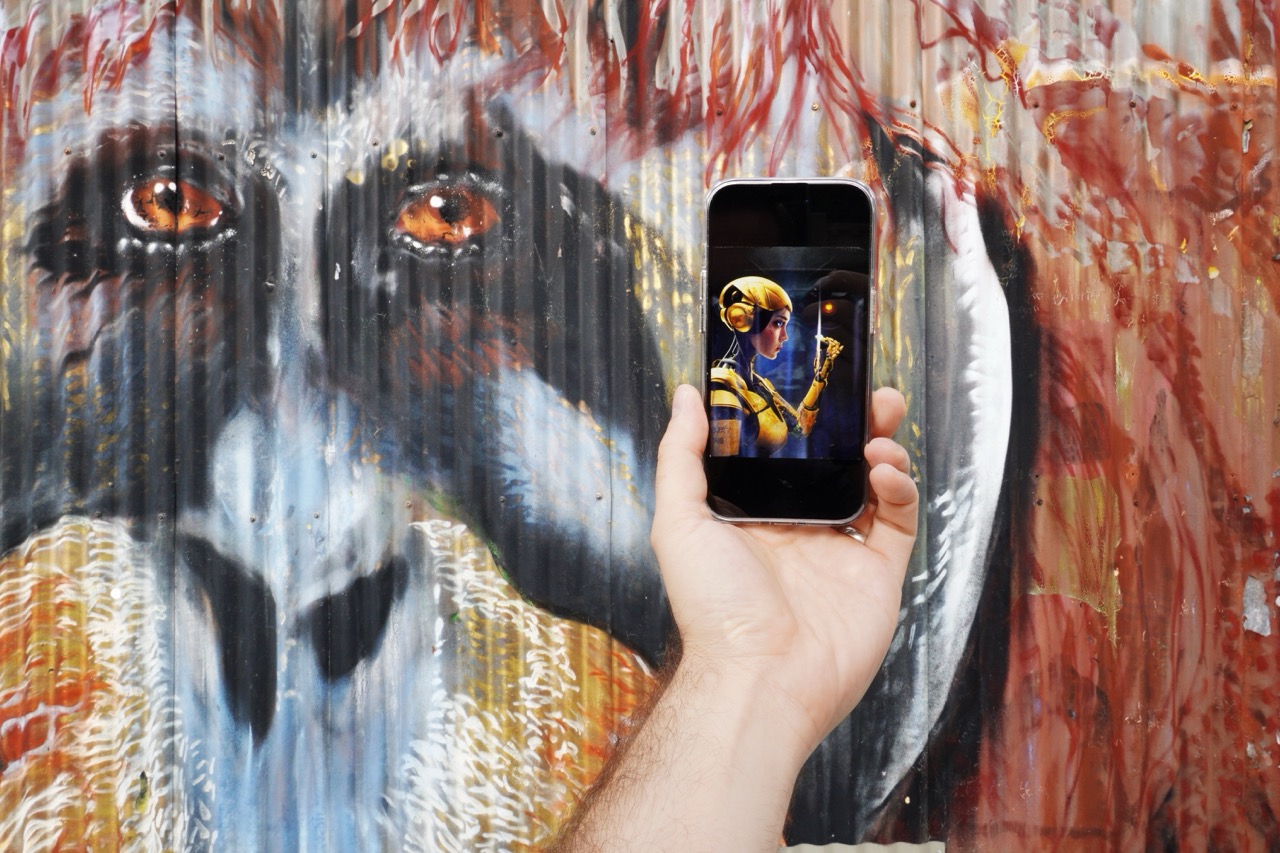
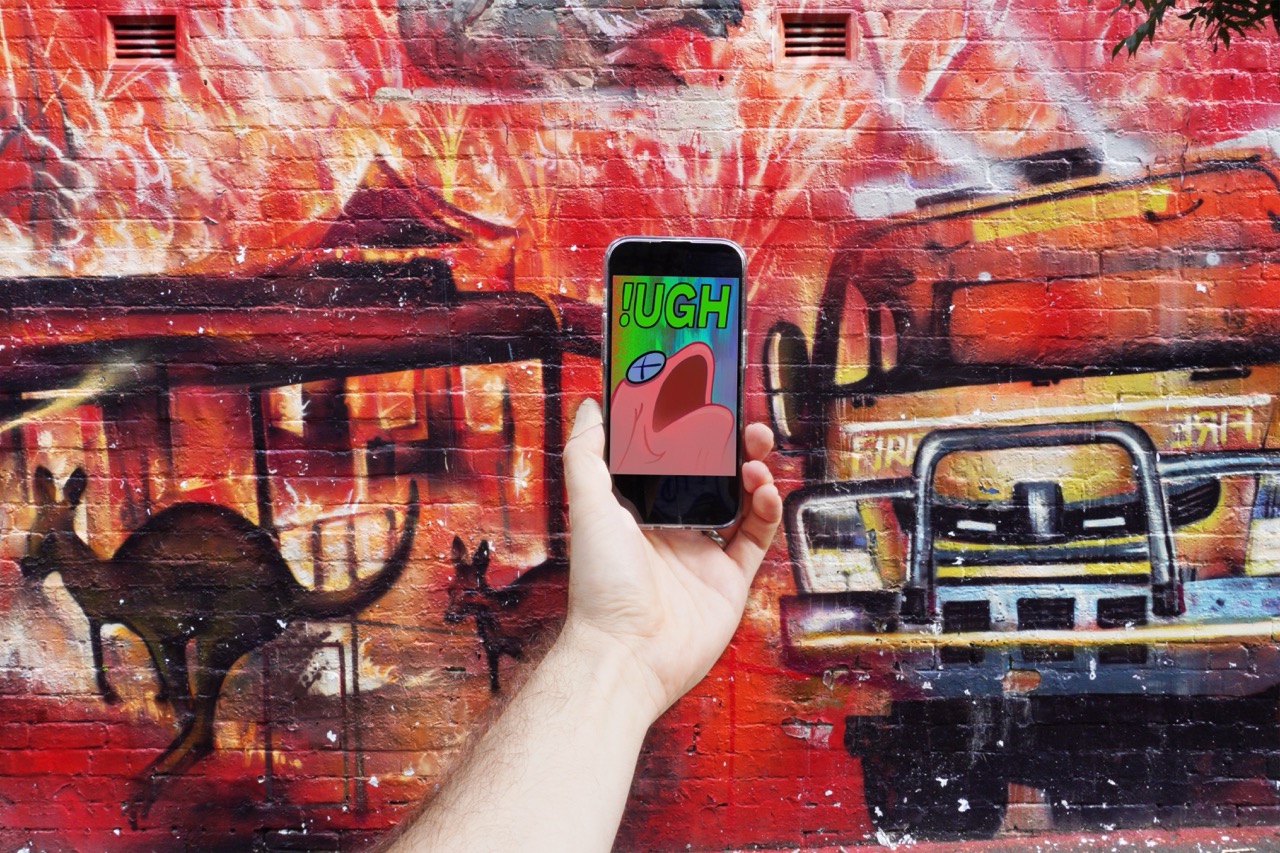
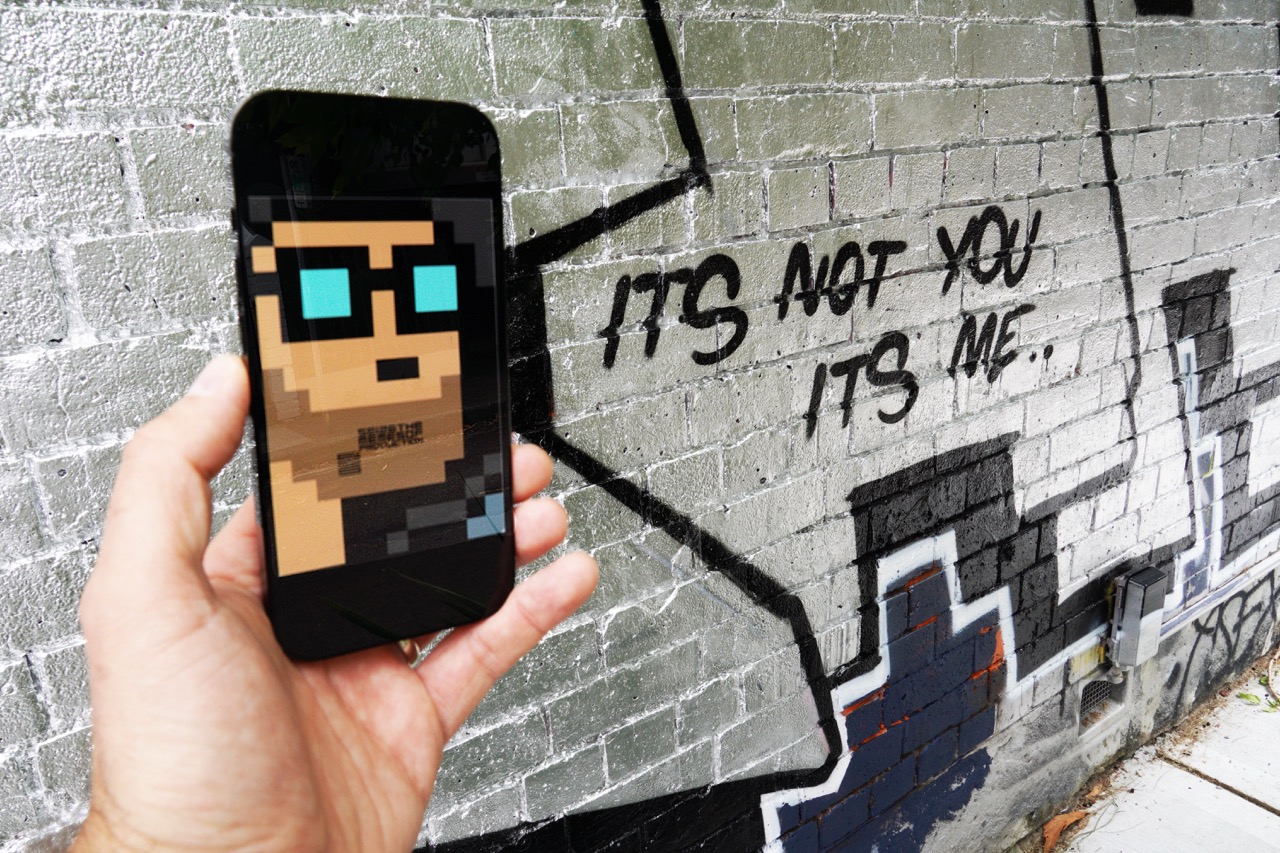
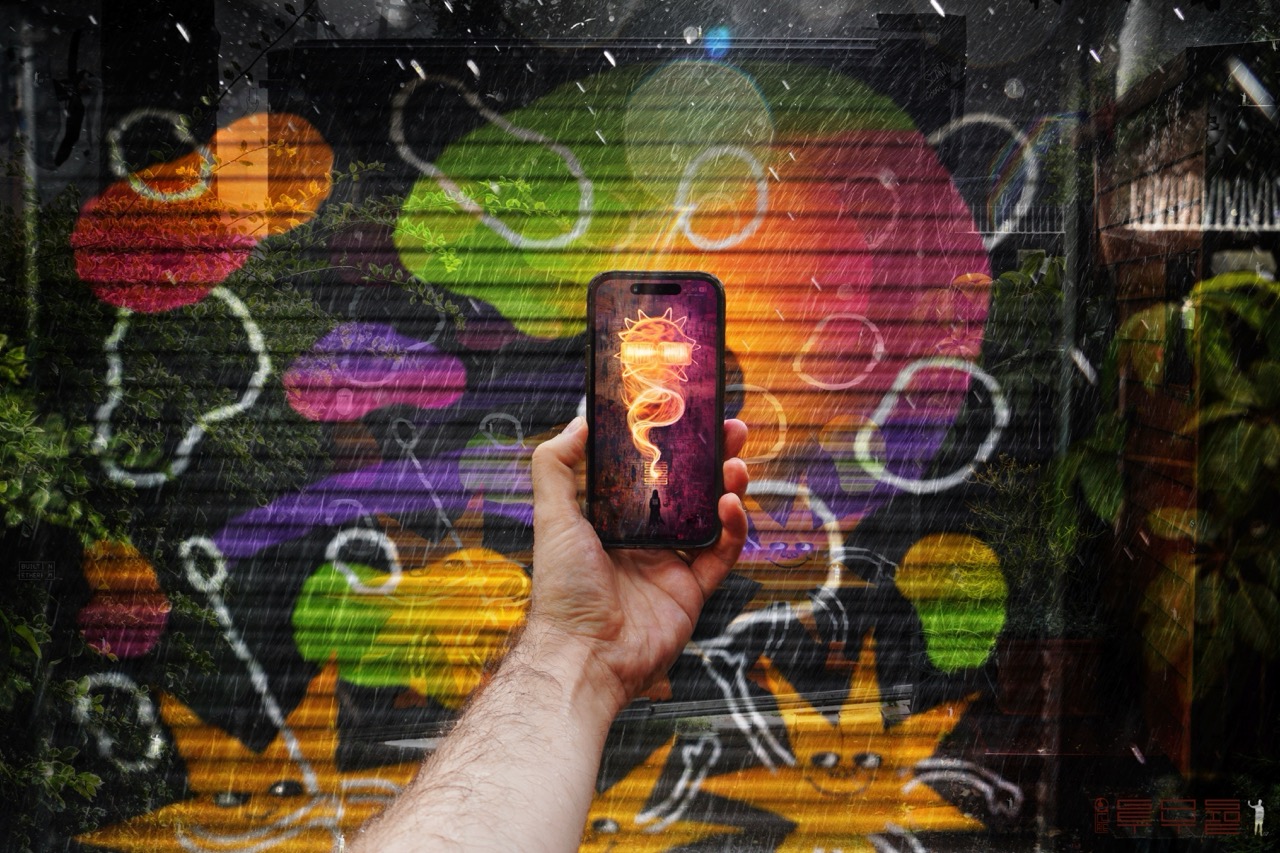
Here is an example of how to do it: hold a phone, displaying a minted digital artwork, at arm's length in front of a painting on the streets of Newtown, in Sydney's inner west.
The hand is human, wrinkled, repairing. The artwork is digital, transferrable, immutable. The wall behind them is sturdy and may be painted over by next week.
Each photograph in this body of work is, in a specific sense, an artwork about the nature of digital objects: holding them up to the light, taking them outside, photographing them in the one place they were never supposed to go.
This is work about the space between the screen and the wall, and why that space matters.
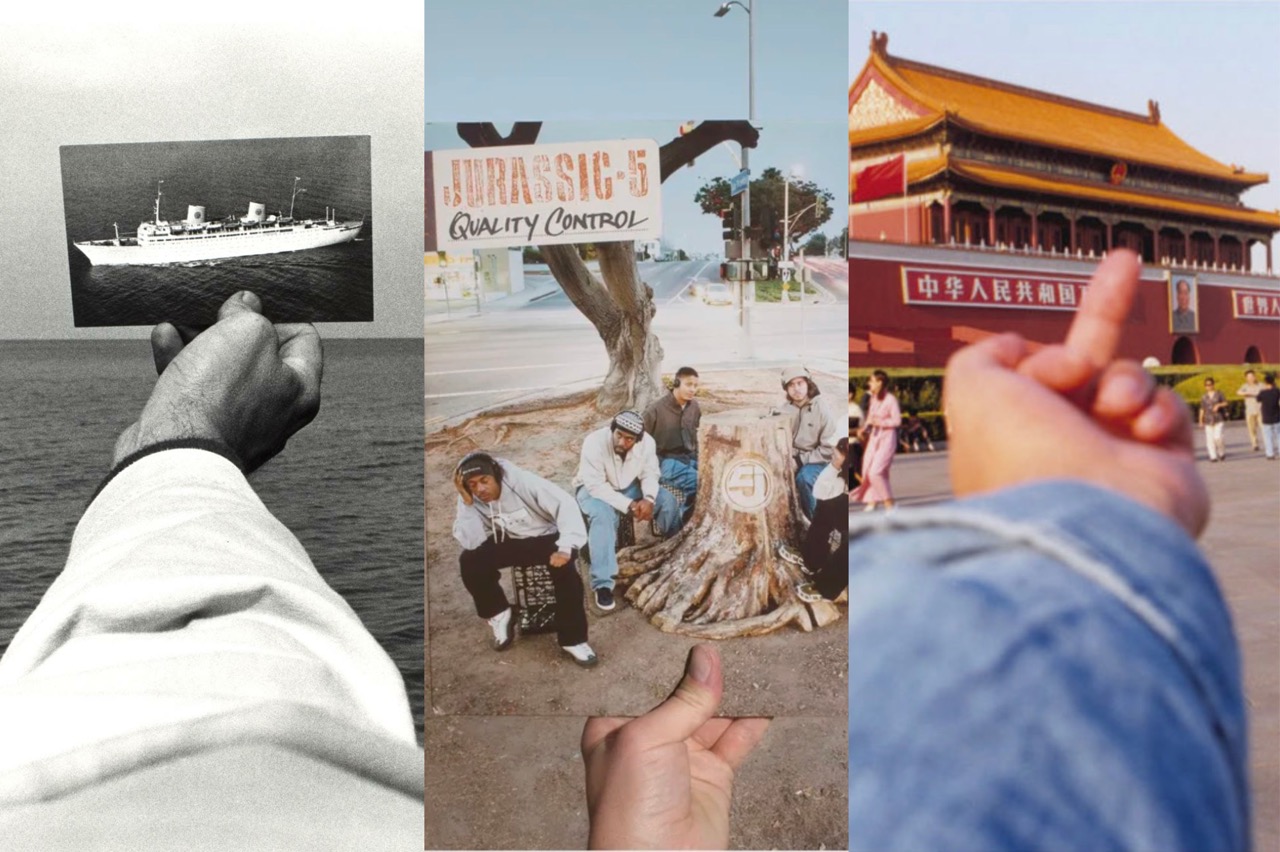
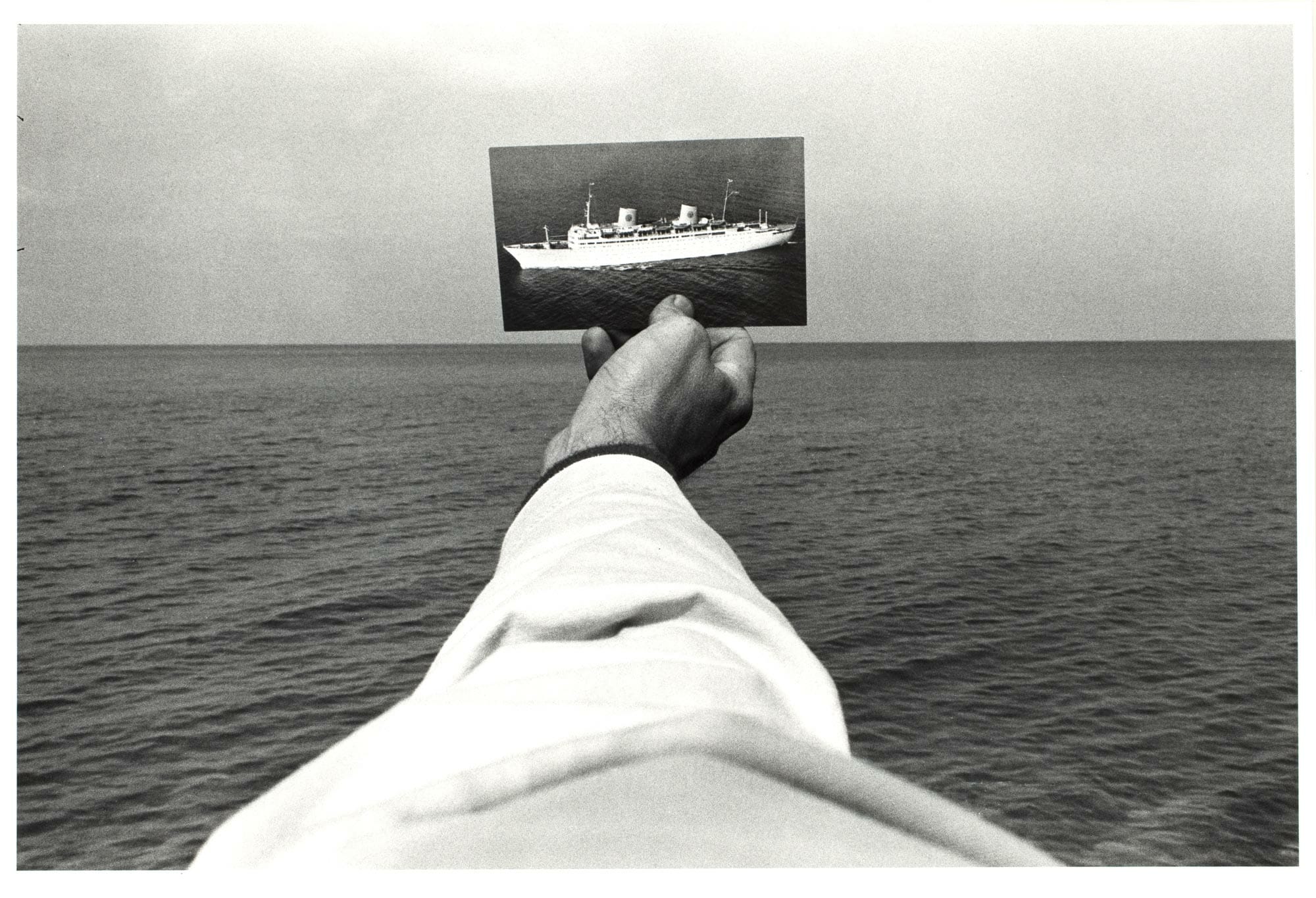
There is a photograph taken in 1970 that contains, somewhere inside it, the seed of everything that follows here. Kenneth Josephson, a Chicago-trained photographer with a lifelong interest in what photographs actually are as opposed to what we assume them to be, made a photo of his own hand holding up a postcard image of a ship against the real horizon. This postcard was made by an anonymous photographer unknown to Josephson. Even in 1970, this distance became part of the meaning of the piece.
Josephson's construction causes the viewer to question assumptions about representation and scale, about what counts as real. For Josephson, the subject of the photograph was photography itself.
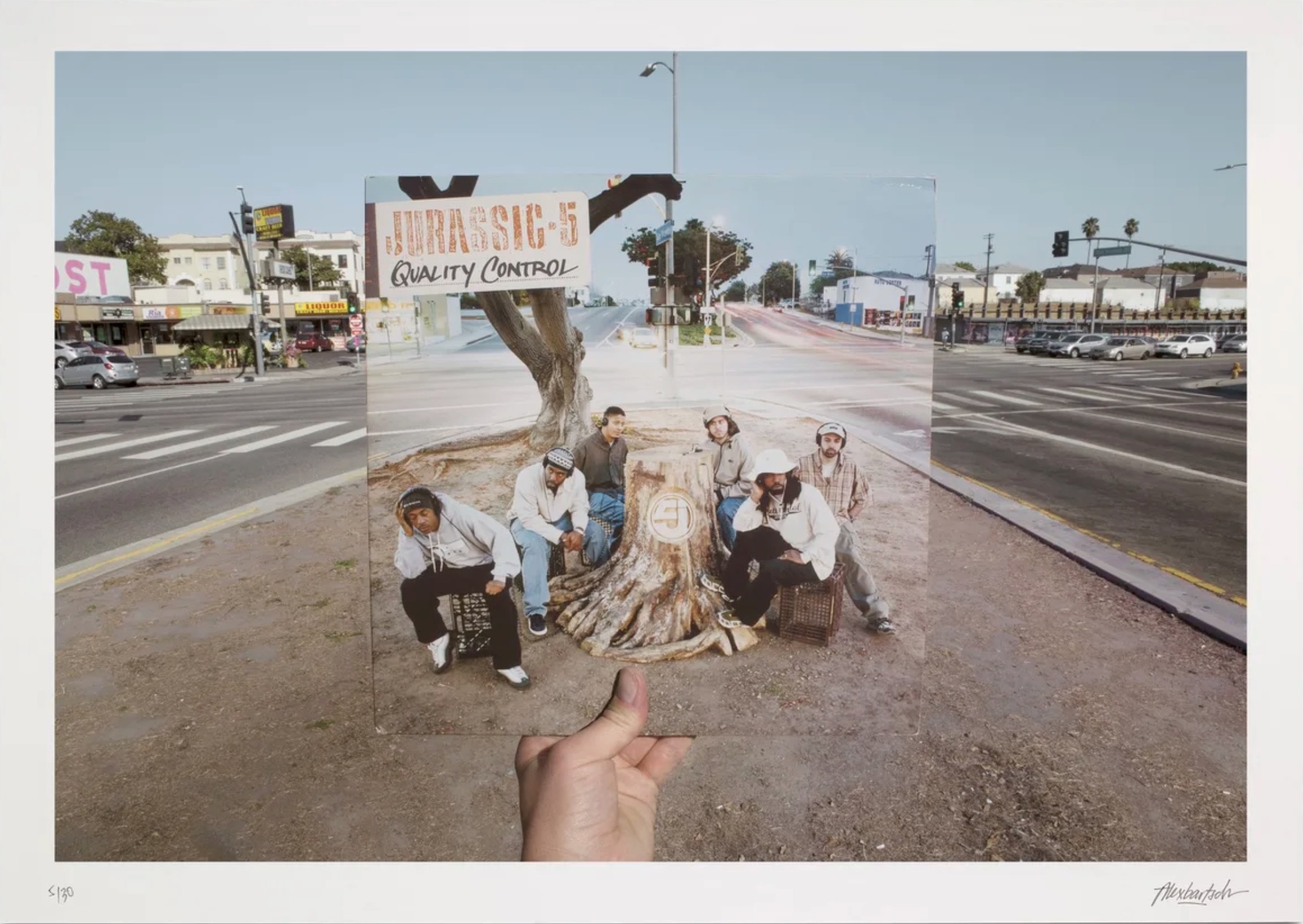
Alex Bartsch, decades later, started his own exploration of images, longevity, legacy and ownership. He began exploring London streets carrying reggae record sleeves whose covers were photographed there thirty, forty, sometimes nearly fifty years earlier. Bartsch held the covers up exactly where they had been taken, in front of whatever those streets had now become, and made a photo. A doorway. A wall. A parking lot where a community had once gathered.
The project Covers approaches a simple question — what does that place look like now? — and becomes a meditation on what places remember and what they forget.
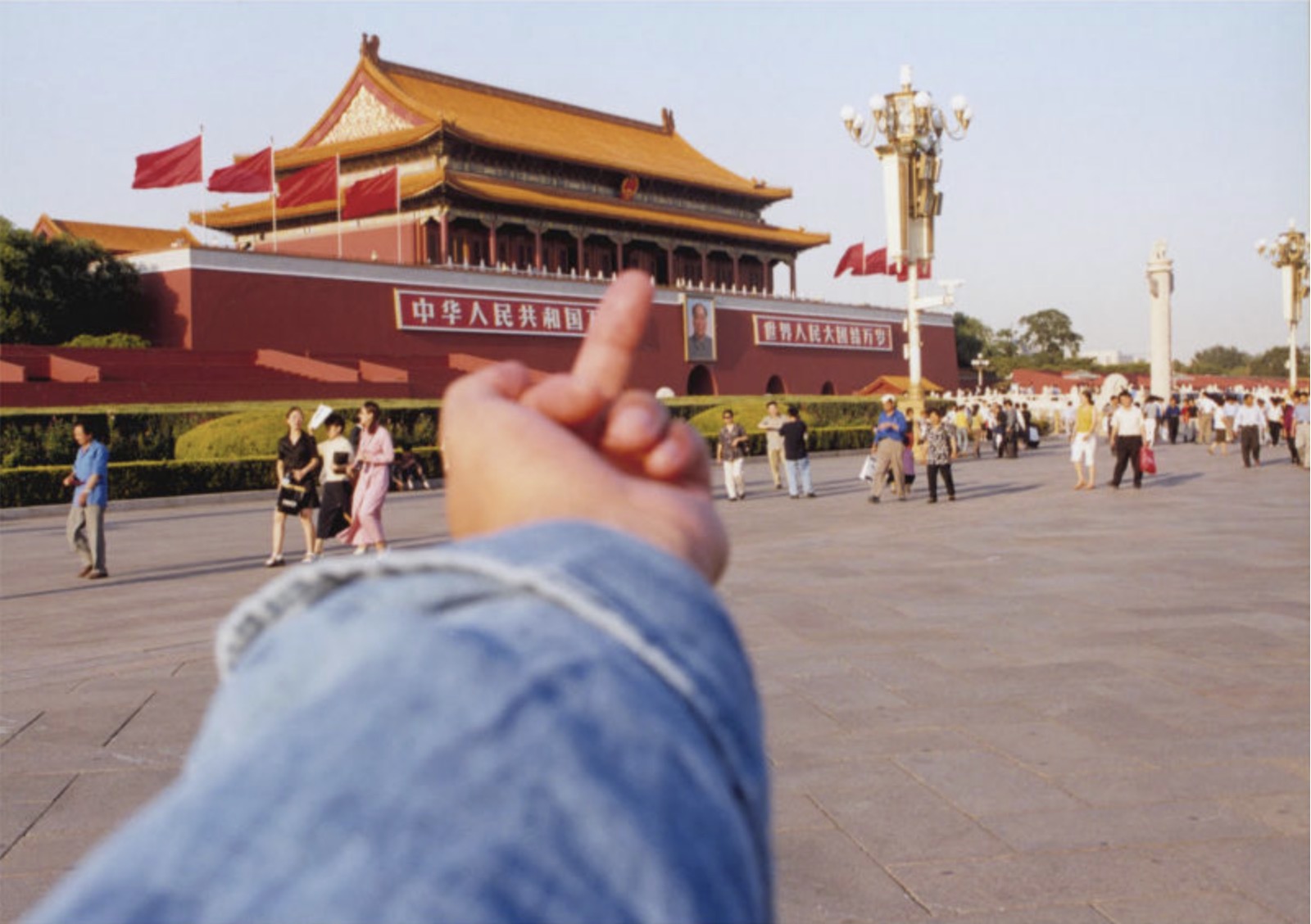
In contrast to Josephson questioning the nature of a photo, or Bartsch returning to where they were made, Ai Weiwei travelled around the world visiting new places and raising his middle finger to them. Weiwei has been seeking out and gesturing towards monuments and institutions of power since 1995: Tiananmen Square, the White House, the Eiffel Tower, the Sydney Opera House. The series is called Study of Perspective, and it began at Tiananmen, where in 1989 a student protest ended in death.
Weiwei's often blurry photos of a common, mildly obscene gesture are so simple they could almost be ignored. They were not. Ai's practice of posting his work publicly attracted sustained attention from Chinese authorities — surveillance, harassment, eventual detention. The hand in front of the institution says: I am here. I am a person. I have my own perspective. These photographs are the proof.
These three photographers, working decades apart, on different continents, with entirely different intentions, share a visual language. In each case: a hand, an object or gesture, and a background. In each case meaning is created from the tension between those elements — something neither could produce alone. And in each case the human hand is the agent: not a tool, not a prop, but a claim. A person was here.
What none of these three artists were doing — what none of them had access to at the time — was engaging with the impact of blockchain technology on digital objects and the internet. To understand why that matters, and why it is worth an artist's sustained attention, it helps to understand two things: what the technology actually changed, and what one community chose to do with it.
Something is being lost. Not dramatically, not all at once — but the horizon is narrowing. Our lives are increasingly lived inside systems built by people who profit from our presence there. The digital world offers, in theory, infinite possibility. In practice, the horizon is your subscription tier, the cities are pre-coded, and we find ourselves existing inside those same institutions Weiwei critiqued — but now they are server farms.
This is not a statement of despair. It is an acknowledgement of the situation. And the situation asks something of us: not to simply log off, but to find the places where the tools can still be turned toward each other, toward the street, toward the light. One of those tools is the blockchain — though almost nobody talks about it that way.
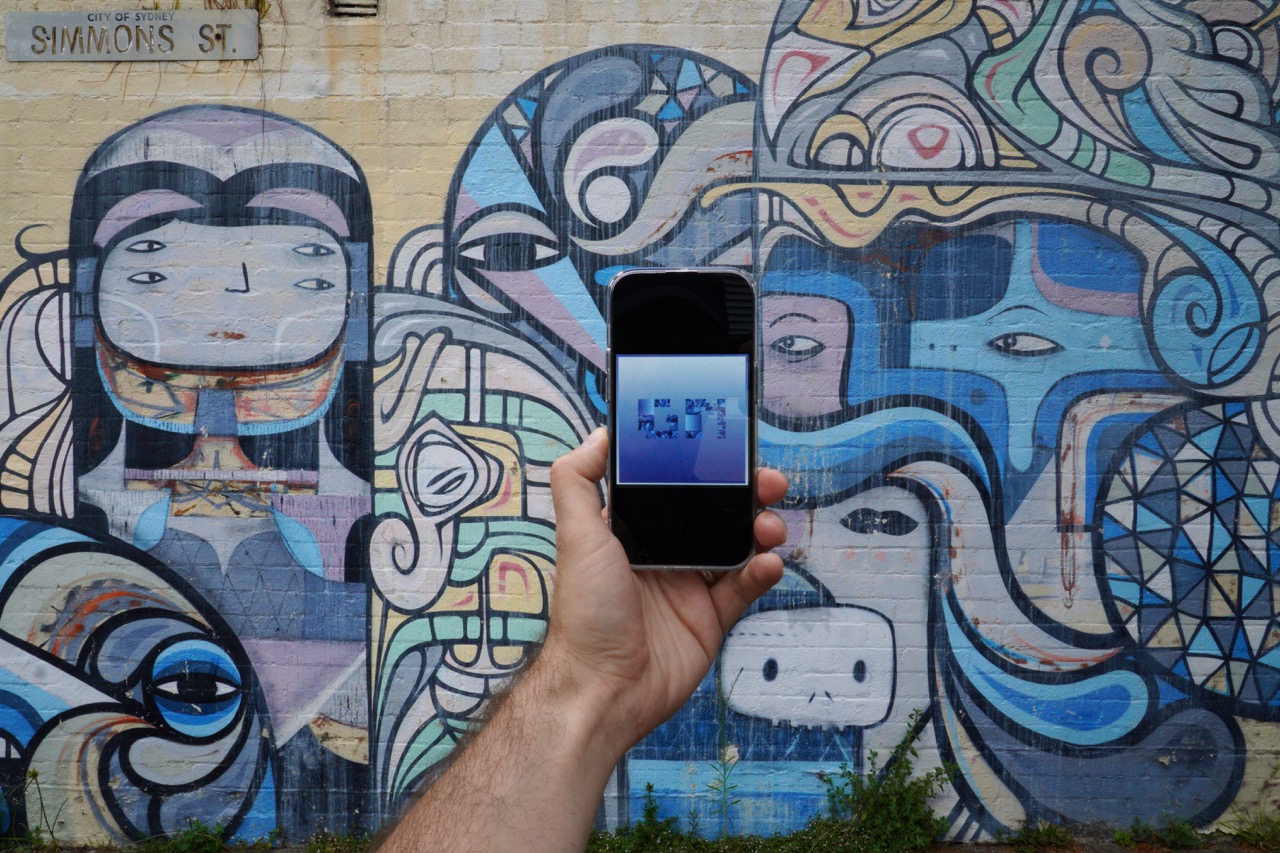
Most people arrive at blockchain through money. They learn about Bitcoin as digital gold, watch the prices move, and pick the speculative tribe they feel they belong to. This is the noise. Underneath it is one genuine innovation, and it has nothing to do with money: it is that blockchain allows a digital object to be owned.
That sounds small but it is not. The internet was built as open space and then, slowly, it was enclosed. Our lives migrated onto corporate servers, into walled gardens, inside platforms owned by someone else. A digital image could be copied infinitely and belonged, in practice, to both no one and to the platform all at once. Blockchain changed that. It created a way to establish that a specific digital object has a specific origin and a specific owner, verifiable by anyone, controlled by no central authority.
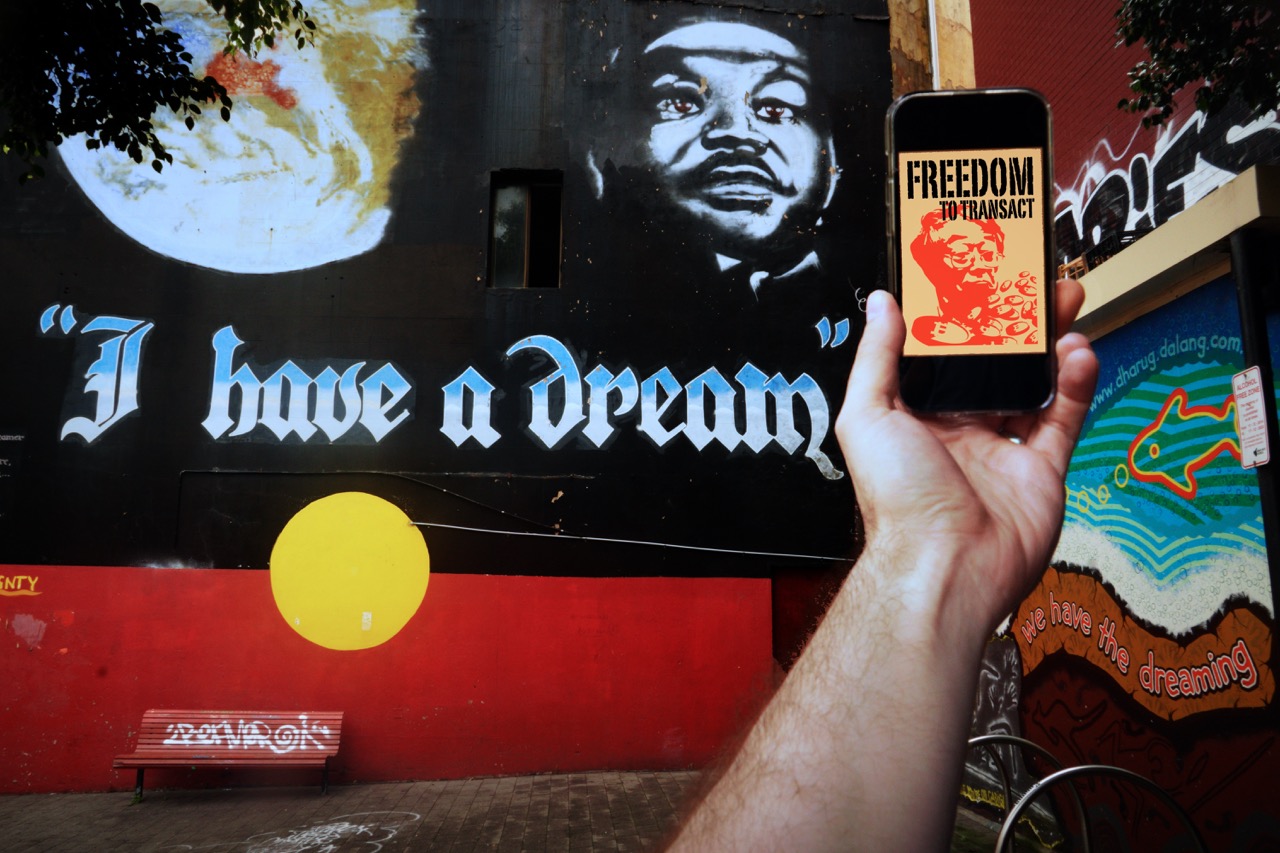
Creating that record is called minting. The objects are often called NFTs — a label that has collected more noise than almost any word of the last decade. This essay mostly sets aside the noise around both blockchain and NFTs in favour of what they actually do: create a digital object that can be owned.
The dominant instinct has been to use this technology to build new walls: to mint everything, establish scarcity, financialise it, fence it in. The arrow points one way: drag the whole physical world on-chain and sell it. It is a reasonable direction given the ubiquity of the internet. It is not the only one available.
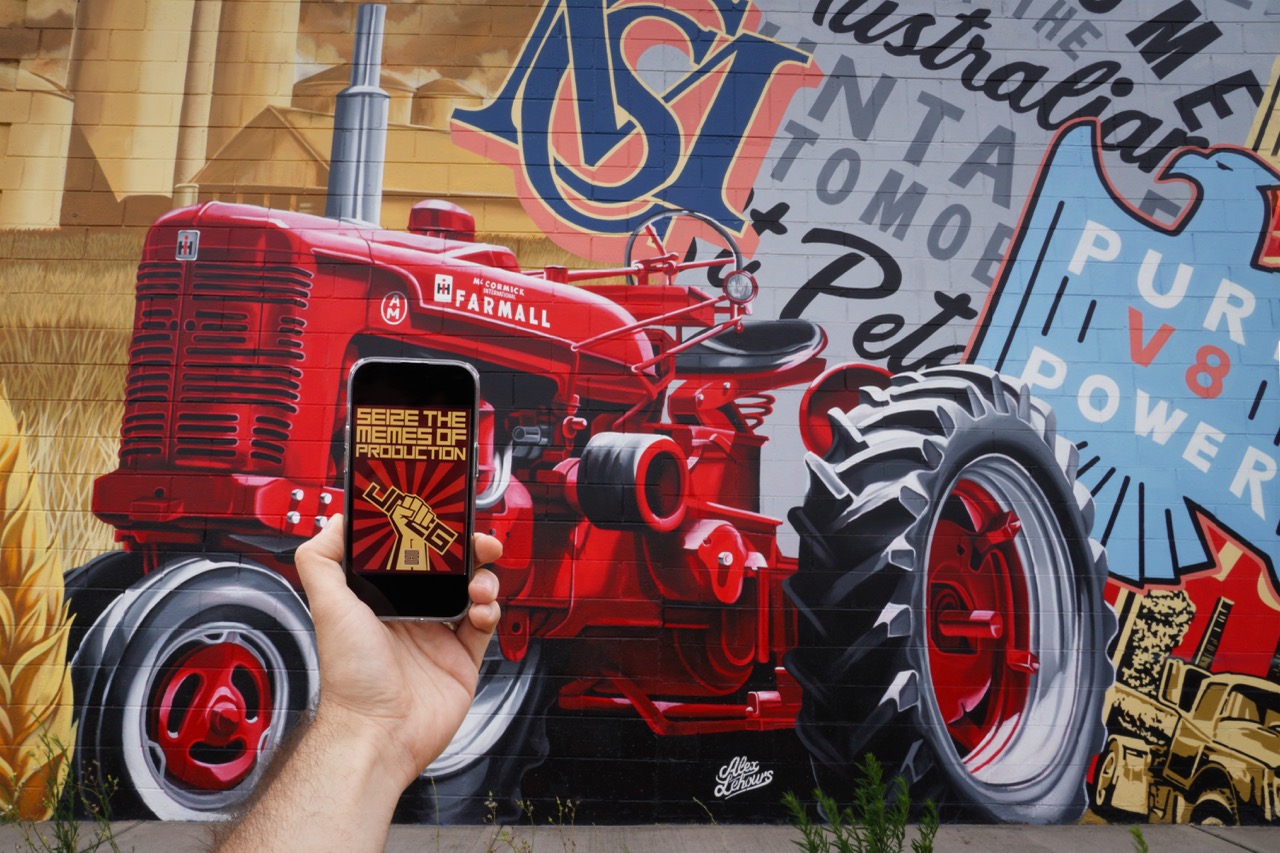
By mid-2022 a collection called The Memes by 6529 was doing something that cut against the entire prevailing instinct with NFTs. In a movement obsessed with ownership and scarcity, The Memes were assertively CC0 — released with all rights surrendered, free for anyone to copy, print, sell, or transform, permanently and irrevocably.
This looks, at first, like throwing the innovation away. Why use a technology built to establish ownership and then give the ownership up? But this is the radical move, and it is worth slowing down for. When an artist releases work as CC0, they keep the only thing that actually matters: the ledger still records that they made it first. They surrender all control and lose nothing of consequence. Anyone can copy the image. Nobody can copy the fact of its origin.
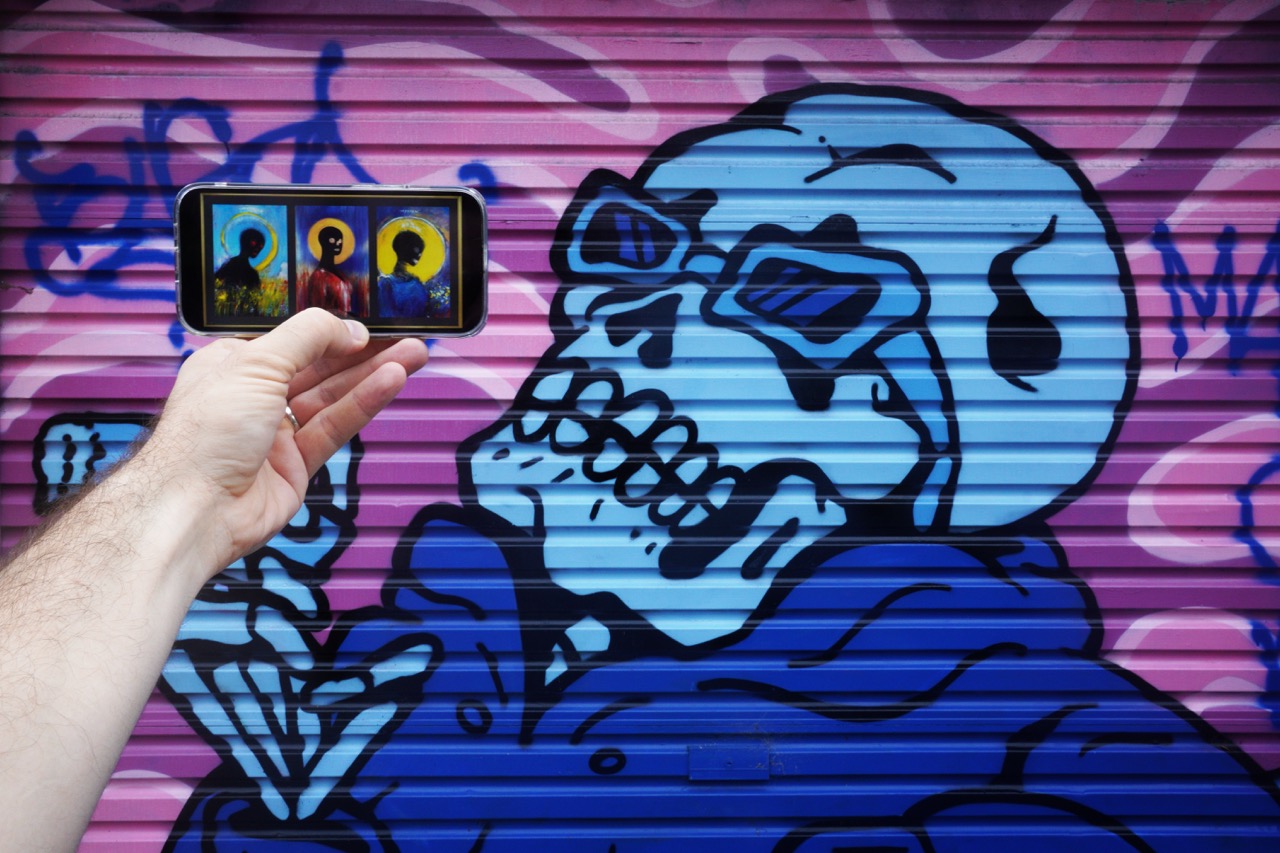
What this produces is an inversion of the whole journey the internet has travelled. The walled garden says: come inside where it is safe, and we will own you a little in exchange. CC0 on a blockchain says the opposite — take the work, it is free, carry it anywhere, and the proof of who made it will survive every copy. The weight of artistic legacy increases the more the piece travels, because every copy is evidence of the original. Every use is a citation. This is individual sovereignty returned to the open internet, not by building a higher wall, but by giving everything away and trusting the technology to keep what counts.
This is why a Memes Outside photograph is not just a picture of a meme. It is an NFT about the nature of NFTs.
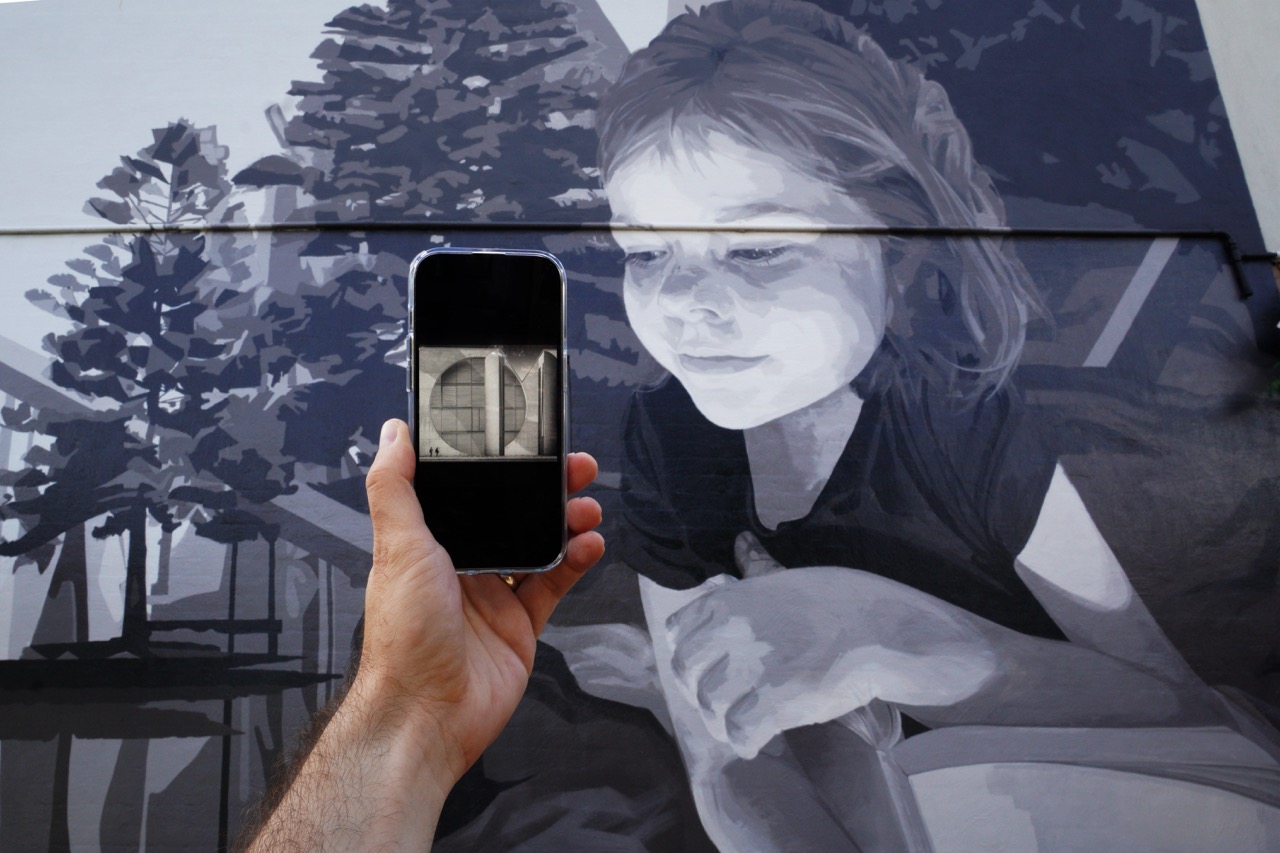
Every Memes Outside photo has been minted. The artwork being held up to the wall in Newtown is the same kind of object as the photograph being made — minted, owned, free — and the photograph is an argument about what that kind of object can be and where it can go. Josephson held a postcard against a horizon to ask what a photograph is. Memes Outside holds a minted image against a painted wall to ask what ownership is, now, for objects living on an internet that forgot it was ever supposed to be free.
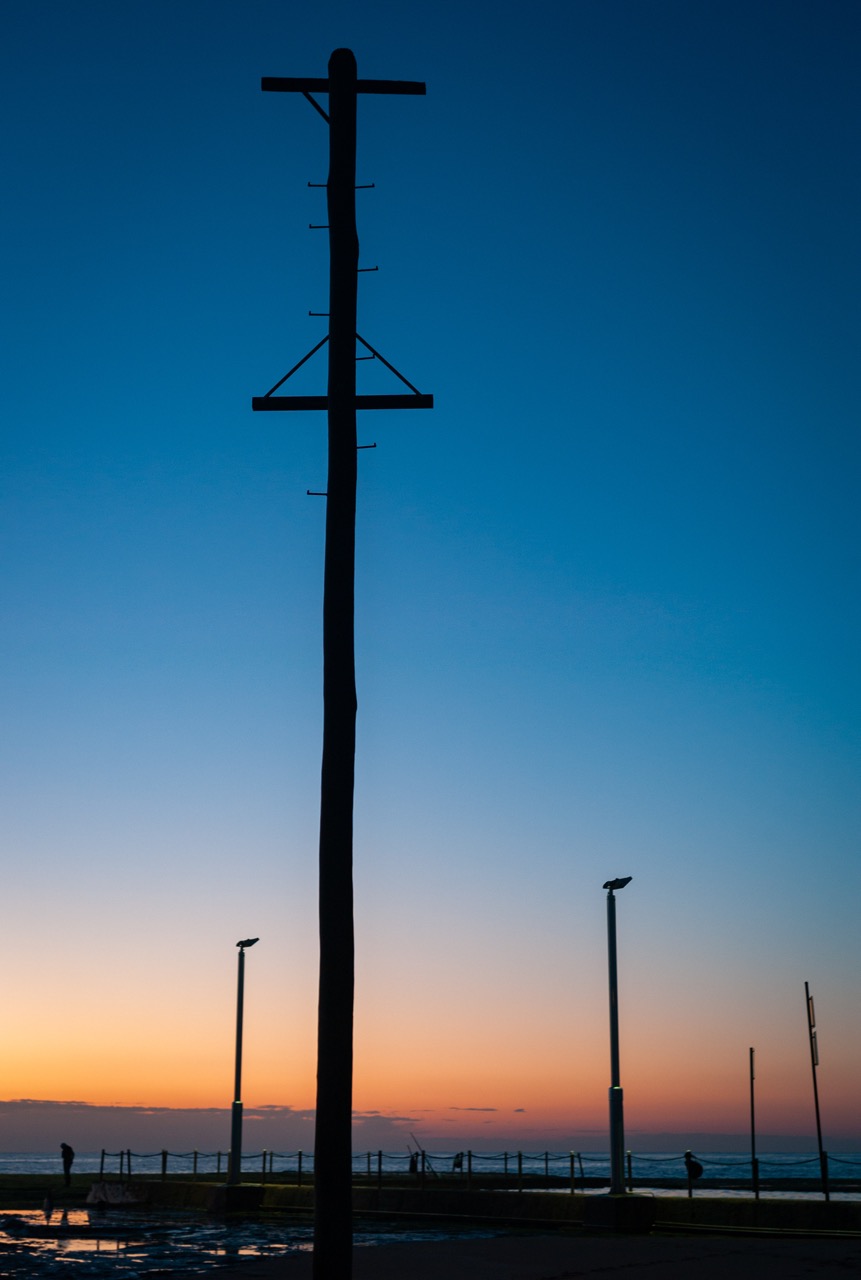
The instinct to create this work did not begin with a phone and a street. It began with a question, asked in public.
In May 2021, the Pixels and Grain Photography Collective — four photographers who had been making film photographs together in Sydney for years — minted four images as a single collection on Ethereum. The collection was called C-Scapes, and it was accompanied by an article published on 35mmc.com, one of the world's largest communities for analog photography. The photographers asked a question that felt genuinely open at the time: can you sell analog photographs on a blockchain?
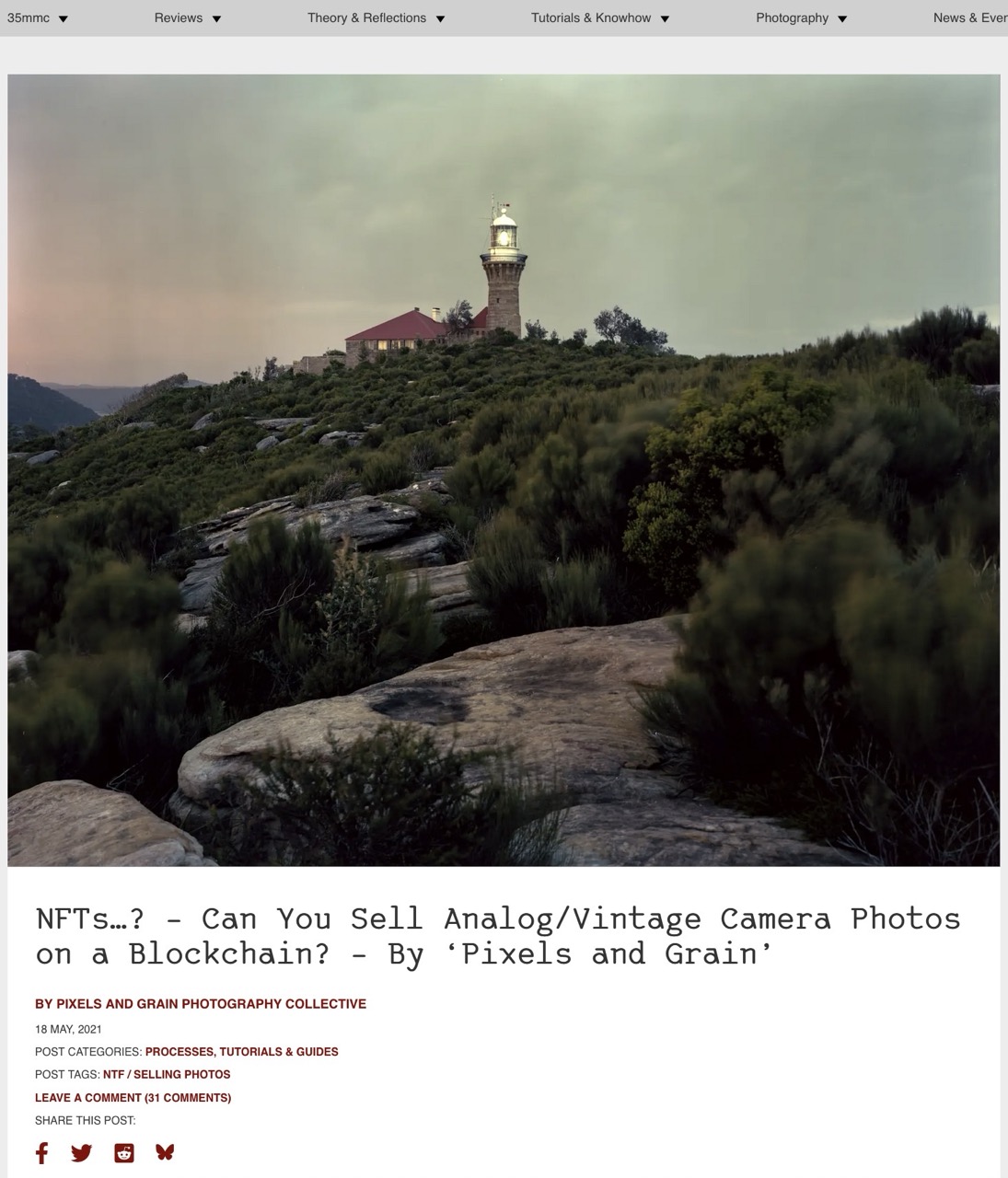
The article was intended to be a gateway for photographers to explore this new technology. It generated hundreds of comments — most of them skeptical, some hostile, a few curious. Which was exactly the point. The instinct behind C-Scapes was not commercial but exploratory: the technology was interesting, and asking the question in public was a way to create learning by galvanising curiosity. C-Scapes may be the first NFT collection on Ethereum to include full photographic metadata: film type, camera, lens, aperture — the whole technical record of how each image was made. This was not an oversight. It was a position. If you are going to claim provenance for a photograph on a blockchain, you should be willing to document everything about how that photograph came to exist.
C-Scapes was for sale but never sold. The analog photography community remained largely unconvinced. Those four friends still photograph together. For one of them, however, the puzzle and promise of the technology was worth pursuing further — and a few months later, The Memes gave that instinct its material.
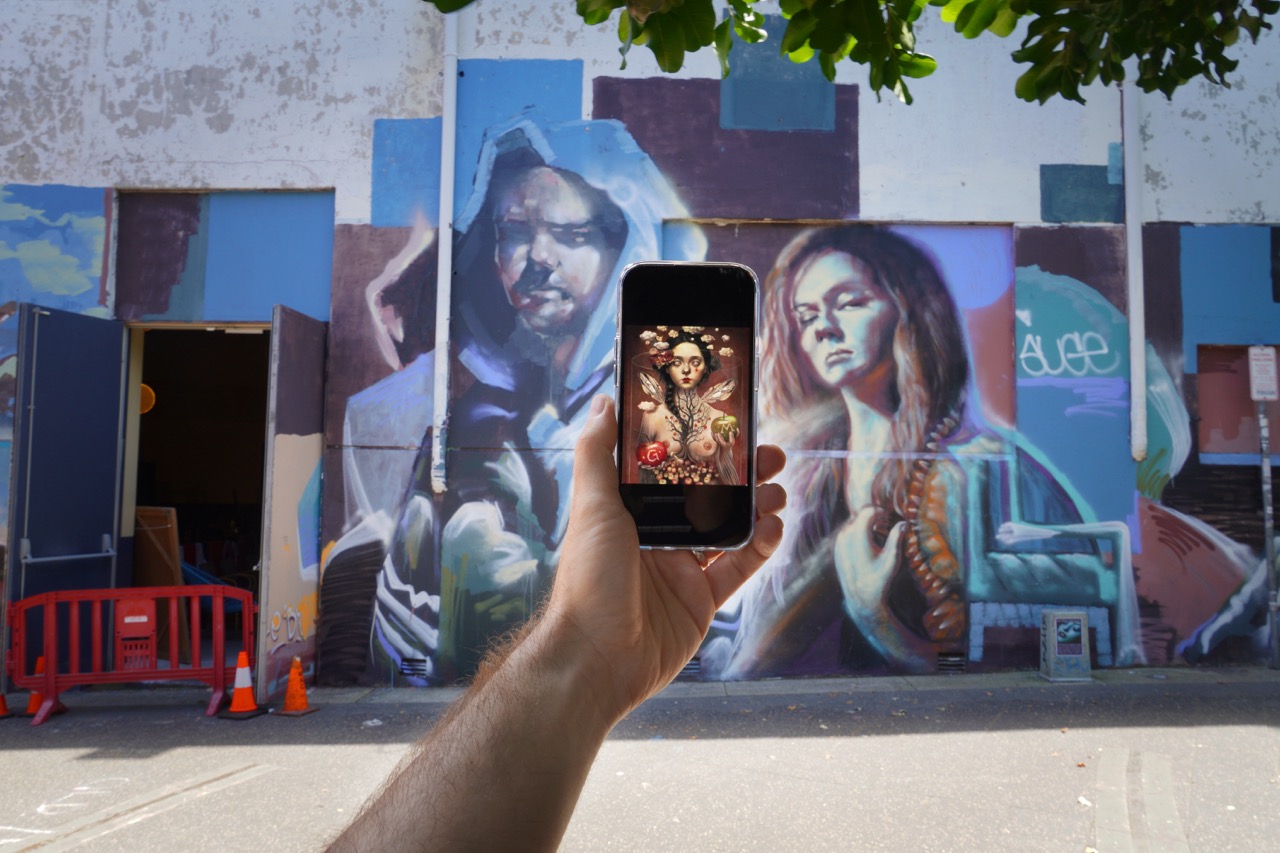
Every core Memes Outside image follows the same compositional logic: an iPhone, held at arm's length, displaying a CC0 meme card from The Memes by 6529, positioned in front of street art that has some thematic or aesthetic relationship to the card on the screen. The hand is always present. The scale is always deliberate — the small screen against the large wall, the digital image against the painted surface, the permanent rendered transient against the impermanent wall that appears immutable.
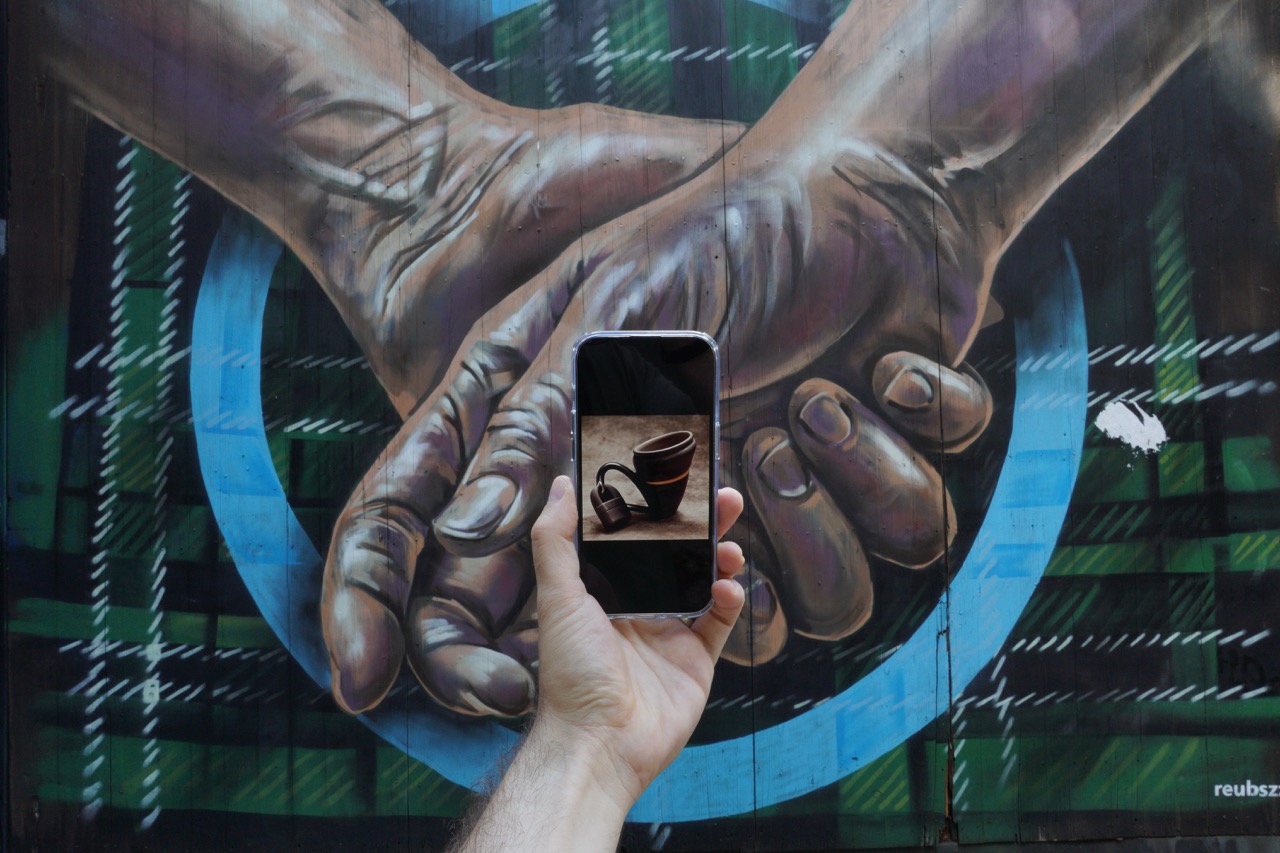
Street art in Newtown and Enmore is made under specific conditions: usually without permission, often anonymously, subject to council removal at any time, occasionally lasting years. It is among the most impermanent forms of visual art that exists. The coordinates of every Memes Outside location are published in the book — and many of those locations, when visited today, show only a painted-over wall. The street art is gone. The minted photograph remains. The blockchain remembers everything. The wall, eventually, forgets.
This is the central tension the collection inhabits. Not a resolution — the blockchain is not obviously better than the wall, and the wall is not obviously better than the blockchain — but a genuine dialogue between two modes of making art visible. Josephson examined the nature of photography itself. Bartsch explored what a place remembers after the people leave. Ai Weiwei used his bare human hand to challenge the institutions of power. Memes Outside asks what we learn about our lives, our choices, and our relationship to the digital world by contrasting something digitally immortal and provenance-locked with a physical context where neither the art nor its setting may last the week.
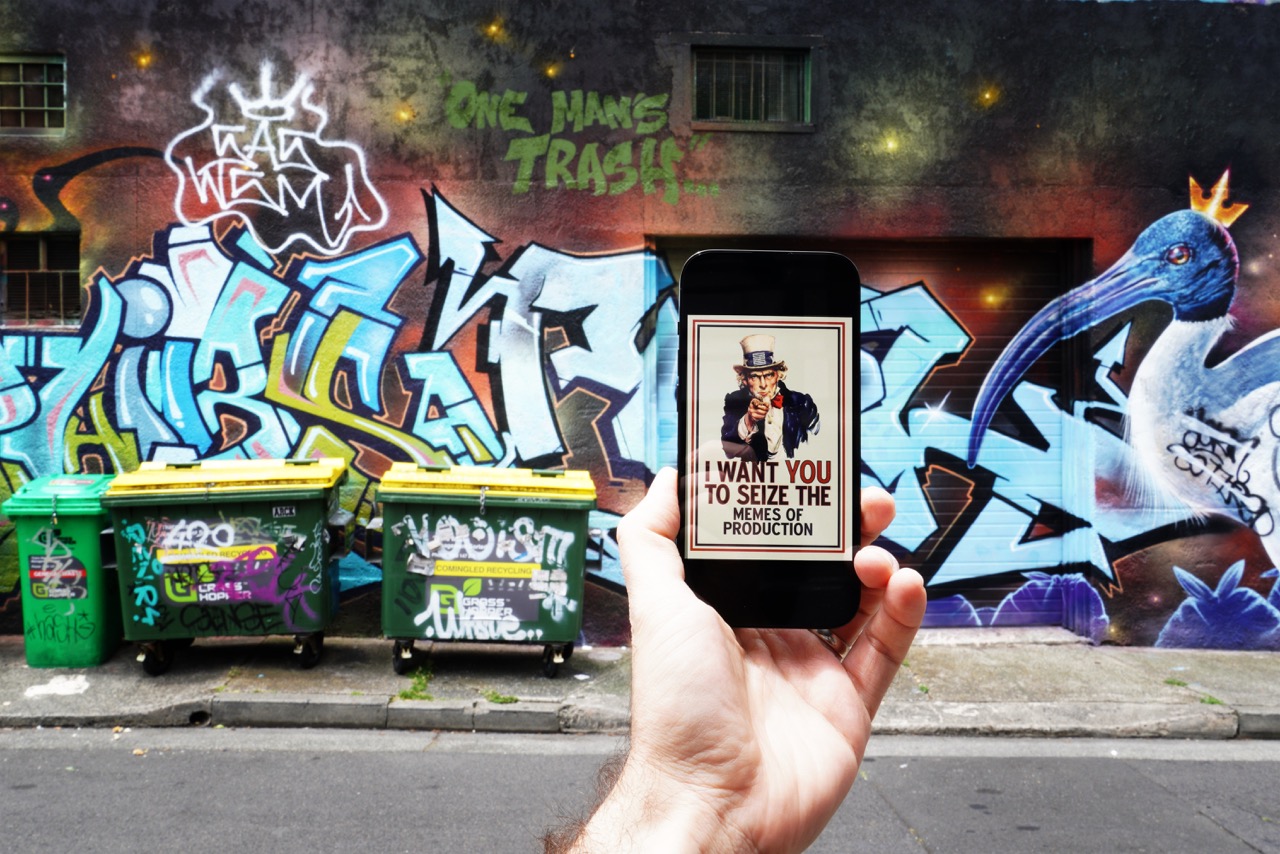
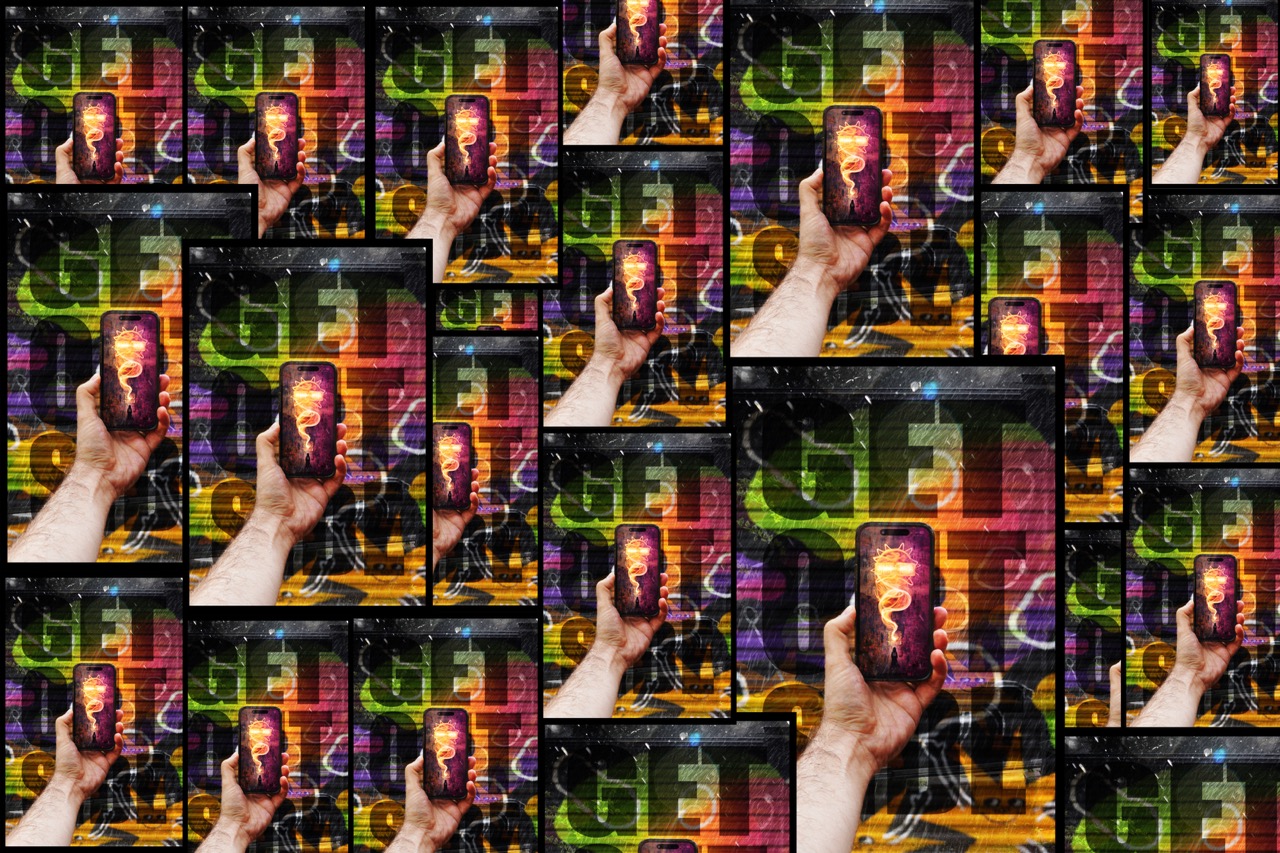
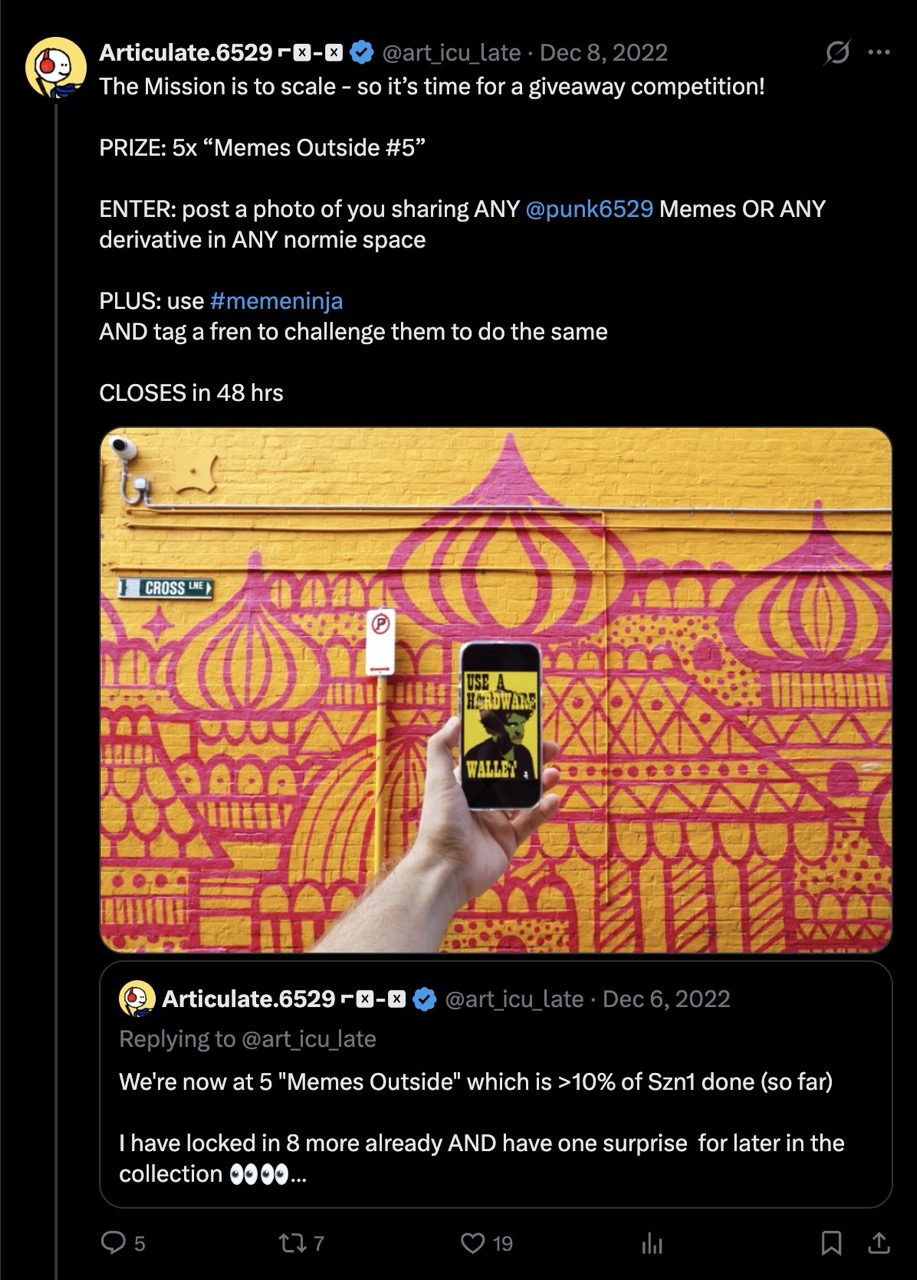
In January 2023, the weekly Meme Ninja competition began on social media: a standing invitation for anyone to bring an NFT outside, photograph it, and share it. No wallet required. No crypto required. No permission required. Just a phone, a hand, and ideally a friend — because photographing something you are holding almost always requires a second person, which means the act of participation is inherently communal.
This became OUTSIDERS: a growing community of people who have taken minted art outside across dozens of countries, whose work is recognised through a reputation system on the 6529 Network, and whose photographs constitute a distributed extension of the original practice.
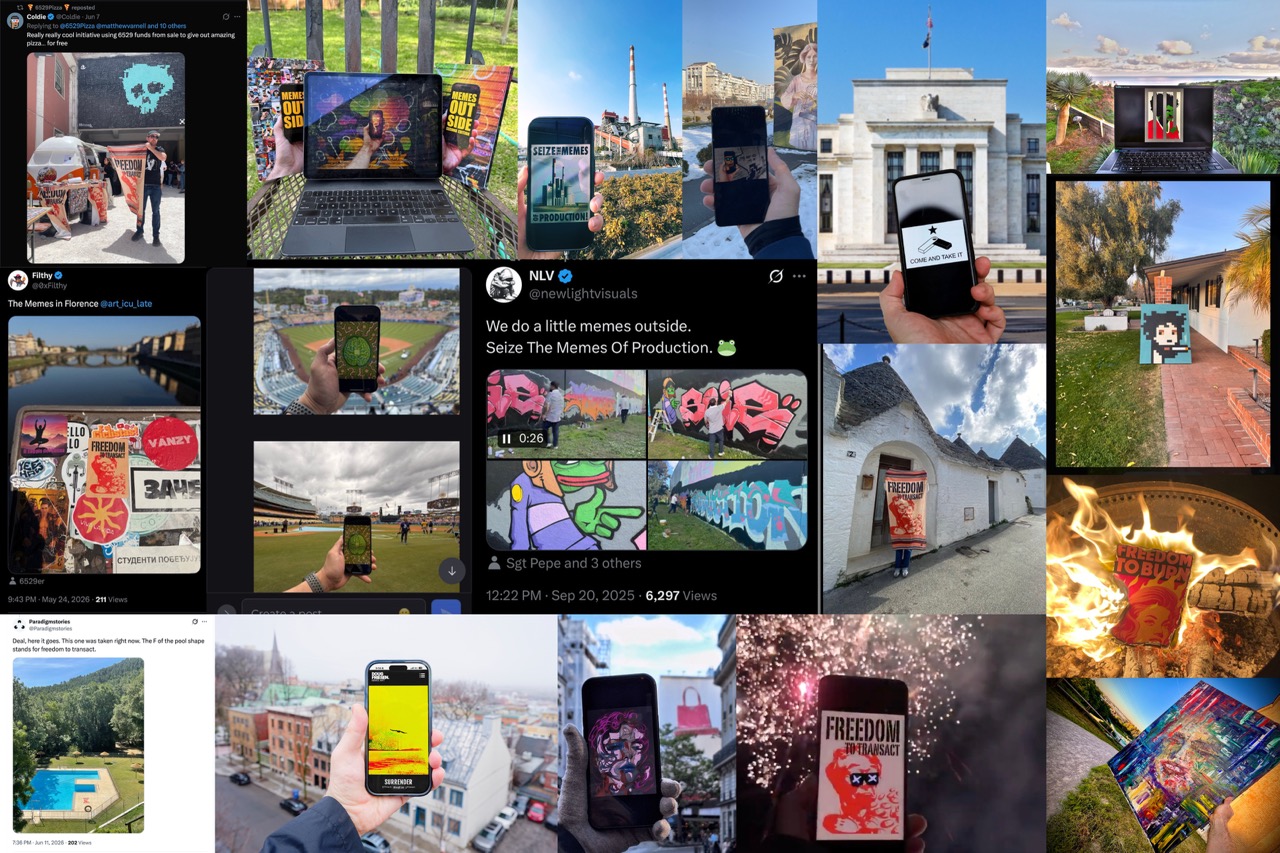
The politics of OUTSIDERS are anarchist — not embracing chaos, but believing in organisation without hierarchy. There is no gatekeeper. There is no application process. There is no committee that decides whether your photograph is good enough. The technology that most loudly proclaims individual sovereignty turns out, in this practice, to generate its most interesting work through mutual dependence: the person holding the phone, the person lending their hands, the street that neither of them owns, the community that welcomes their creations.
This places the work in conscious tension with the dominant rhetoric of blockchain culture, which has often framed itself in terms of individual ownership and financial freedom. The higher-level freedoms available through this technology are not just transactional. They are communal and ethical: not just the right to own, but the capacity to give, to share, to build something that does not require a hierarchy to sustain it.
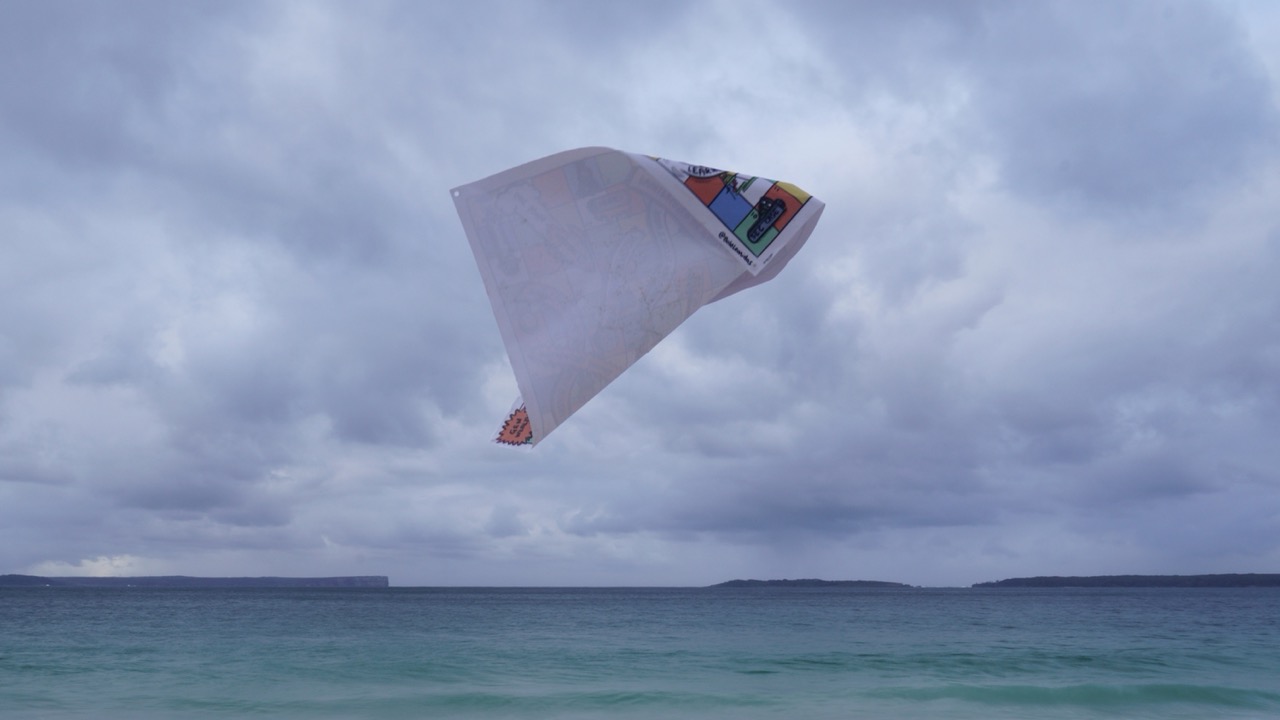
Memes Outside as a collection is now closed. The coordinates are published. Many of the walls have been painted over. But the ideas have continued to expand.
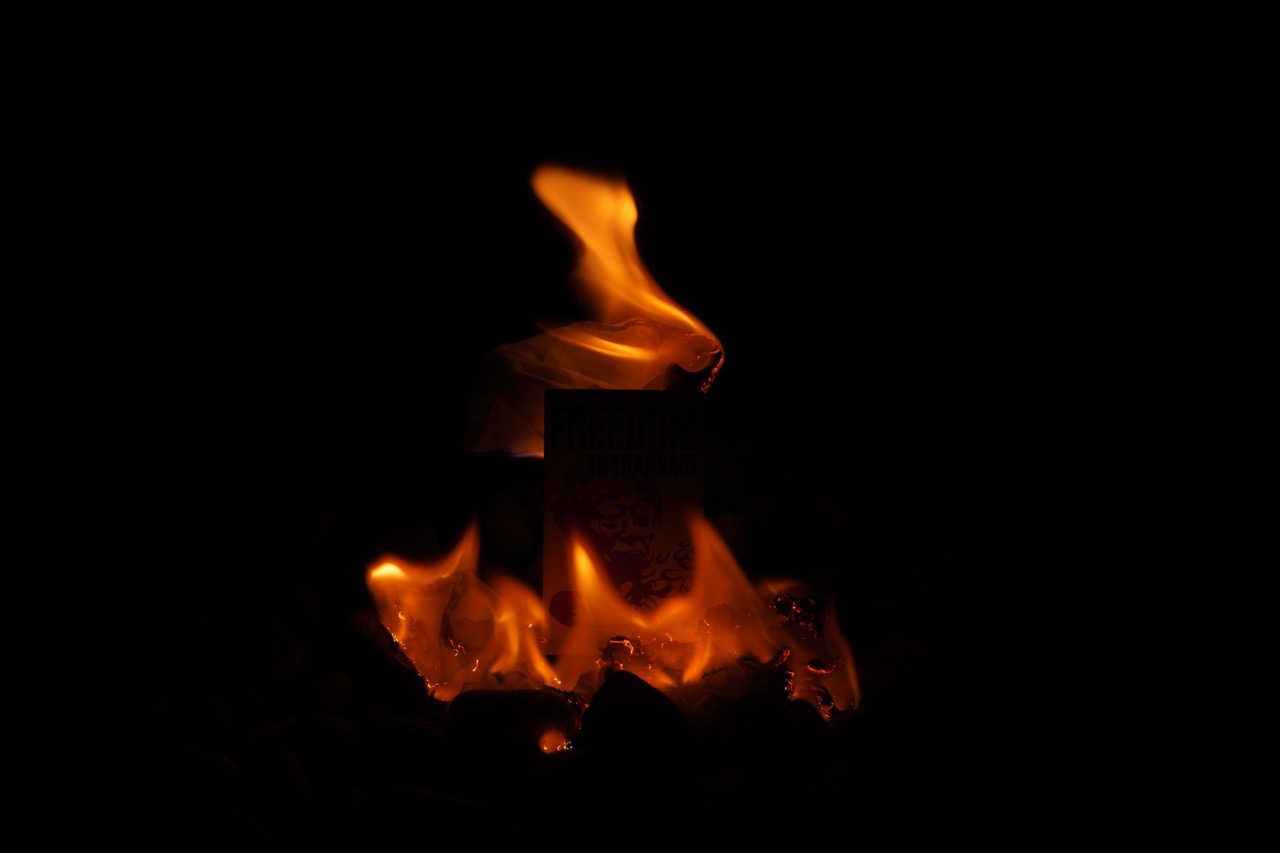
Where Memes Outside was a single collection, what followed was a body of work in which the phone has been set down entirely. The CC0 art is now manifest as fully physical objects. Vinyl prints set in flight over coastal landscapes. Cards immolated, immersed, defaced, reflected, shadowed. The CC0 object removed from the screen and placed into conditions the screen cannot survive — weather, fire, water, time. This is where the original proposition has been pushed furthest, where the hand has learned to let go.
![my[th] #1](https://pub-8d893729b90c4930a50d438e035c09b9.r2.dev/chapter-2/wmmg/wmmg-myth-01.jpg)
More recent collections such as my[th], Wisdom of the True Believers, This Is How I See The World, and Are Ya Coping are parallel bodies of work: aesthetically diverse, technically experimental, but thematically coherent — each one interrogating a different aspect of what it means to make art in, about, and through a technology that most of the world still does not understand and many actively distrust.
There are also experiments in communication and distribution. Memes Outside: The Book, now in its second edition, is archived in the Australian National Library. The books are sold at cost price, they are CC0, and they explore the logic that CC0 needs distribution. Without an audience, the gesture is incomplete. The book travels: printable from any office printer, orderable from anywhere in the world at cost, given away freely, defaceable by design. Copies have arrived in Australia, Iran, Japan, Germany, the United Kingdom, the United States.
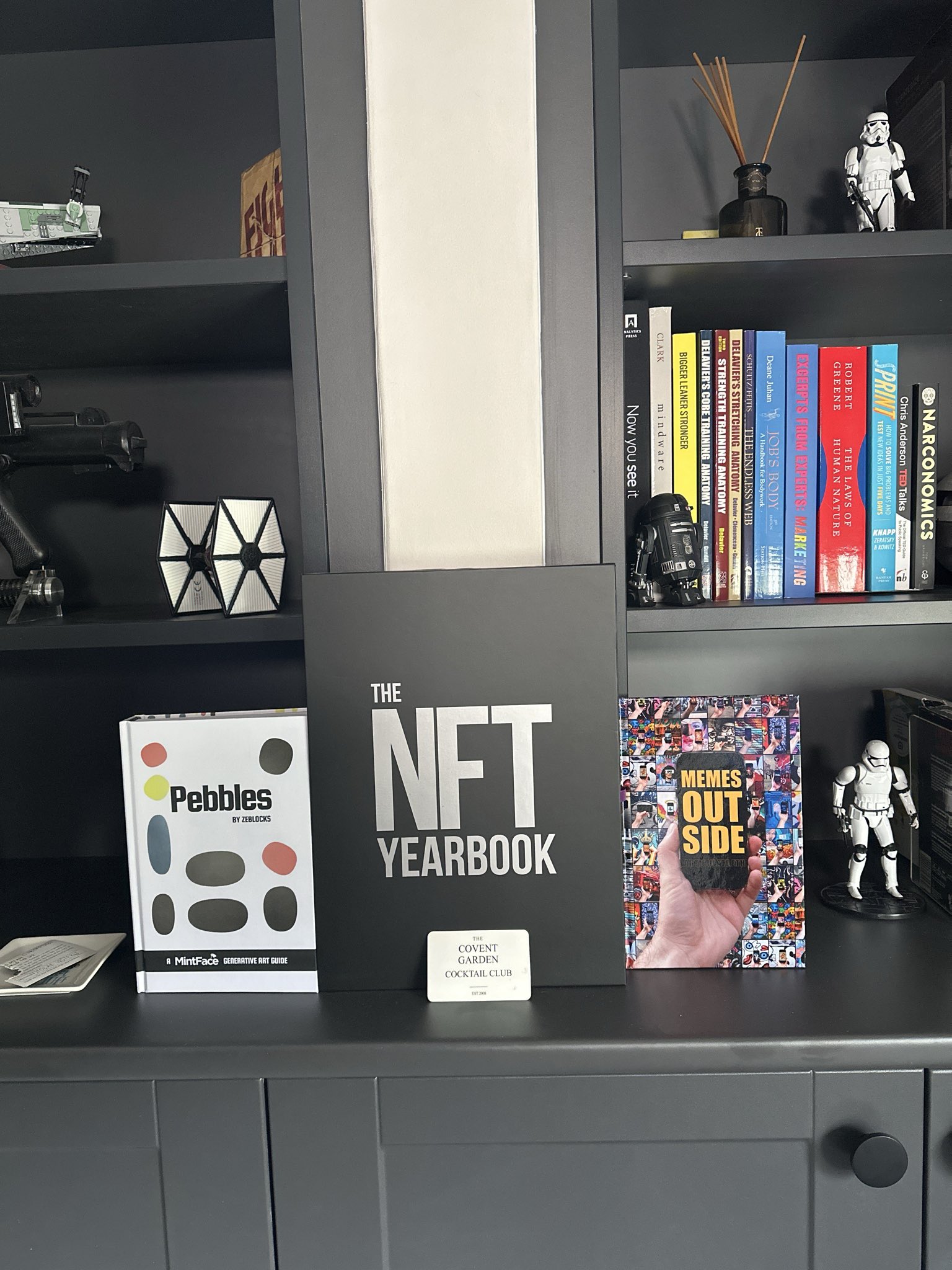
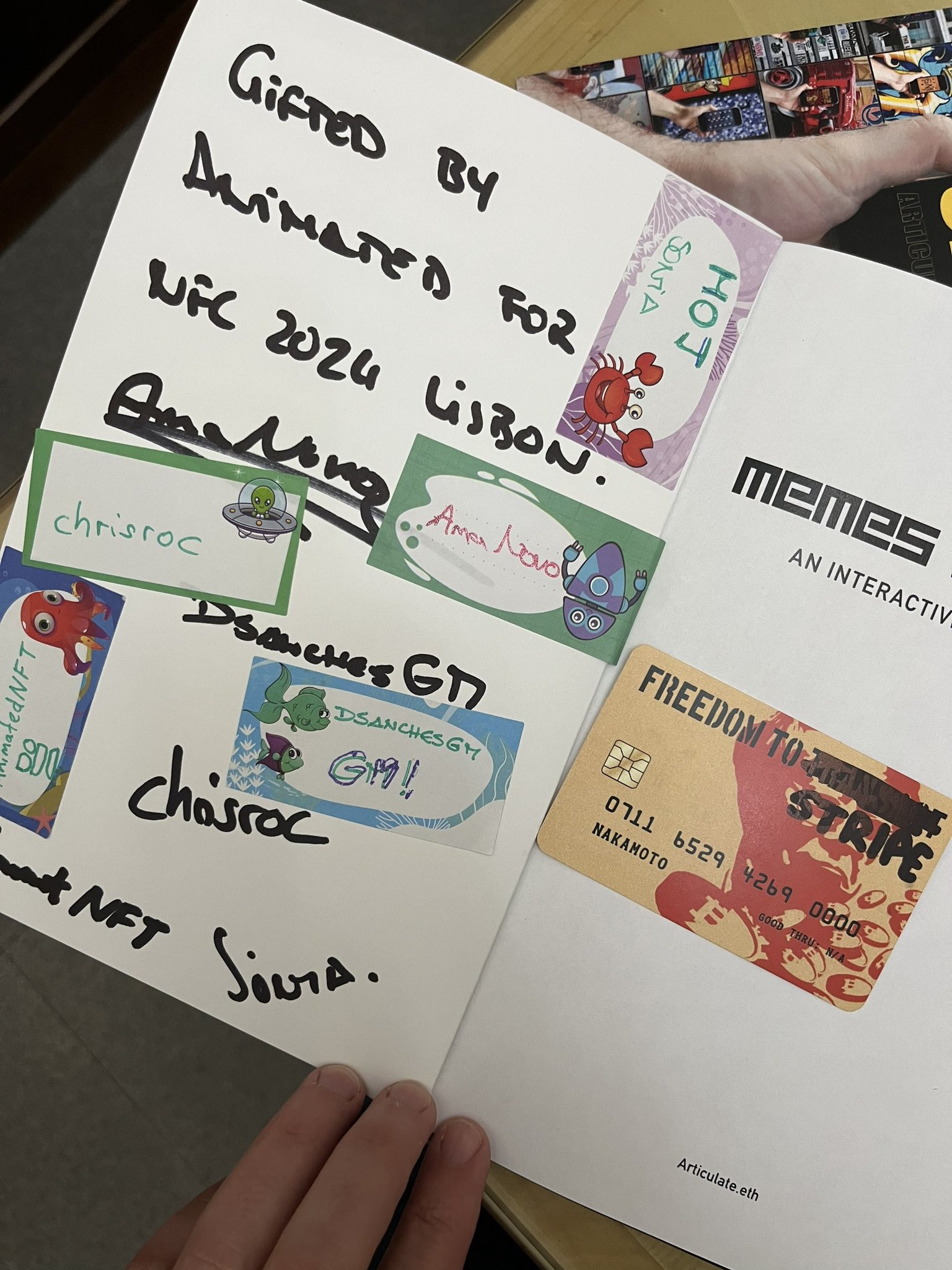
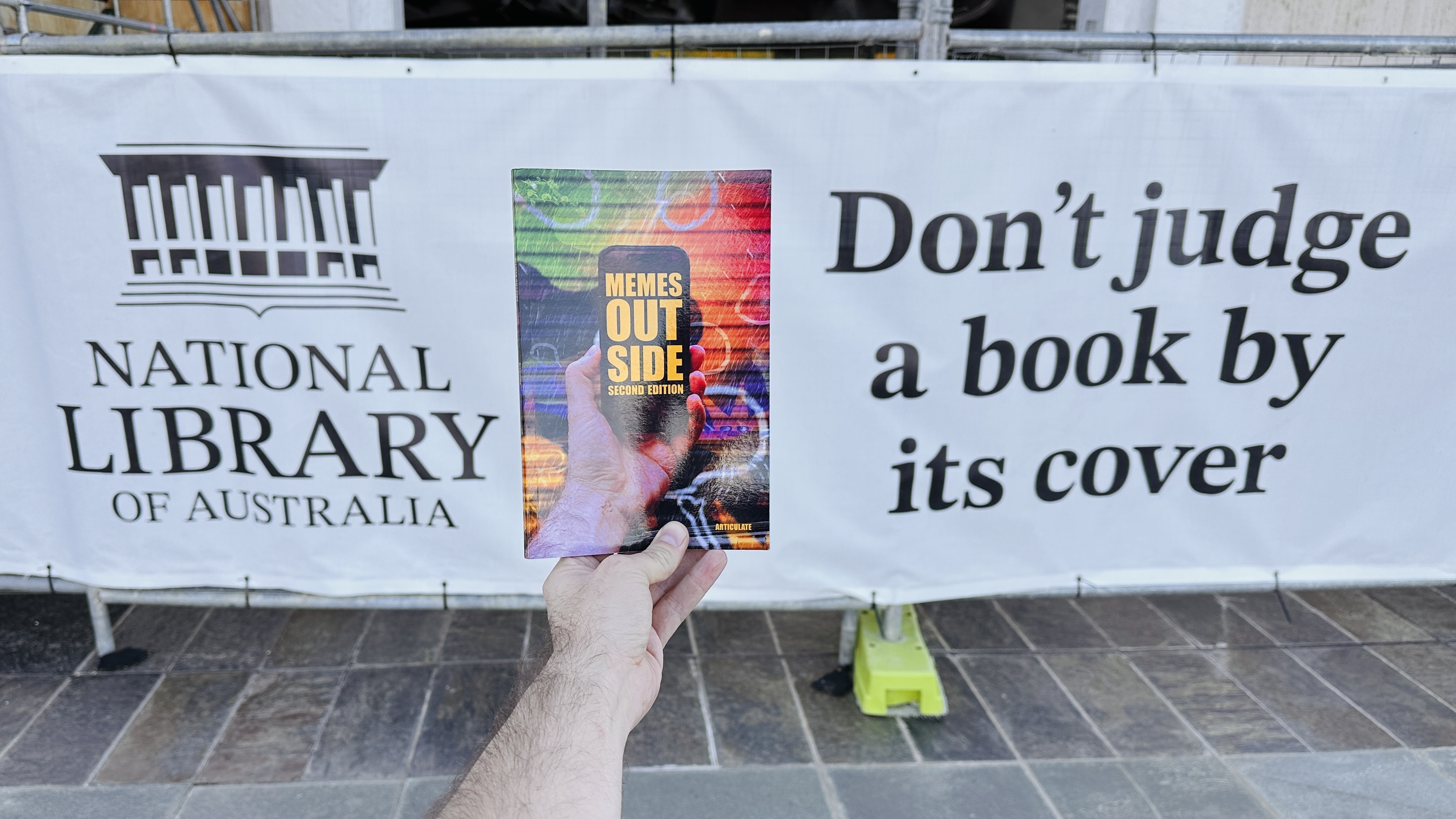
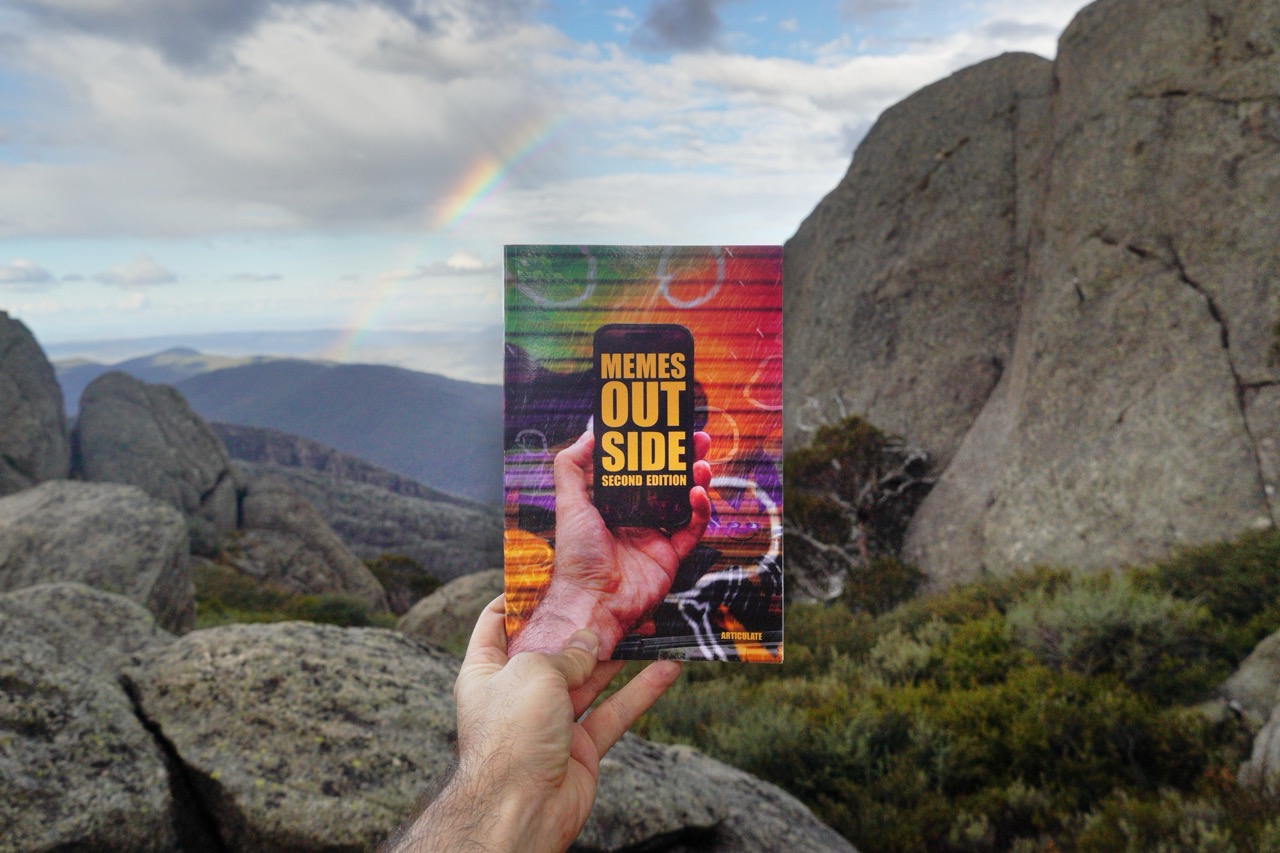
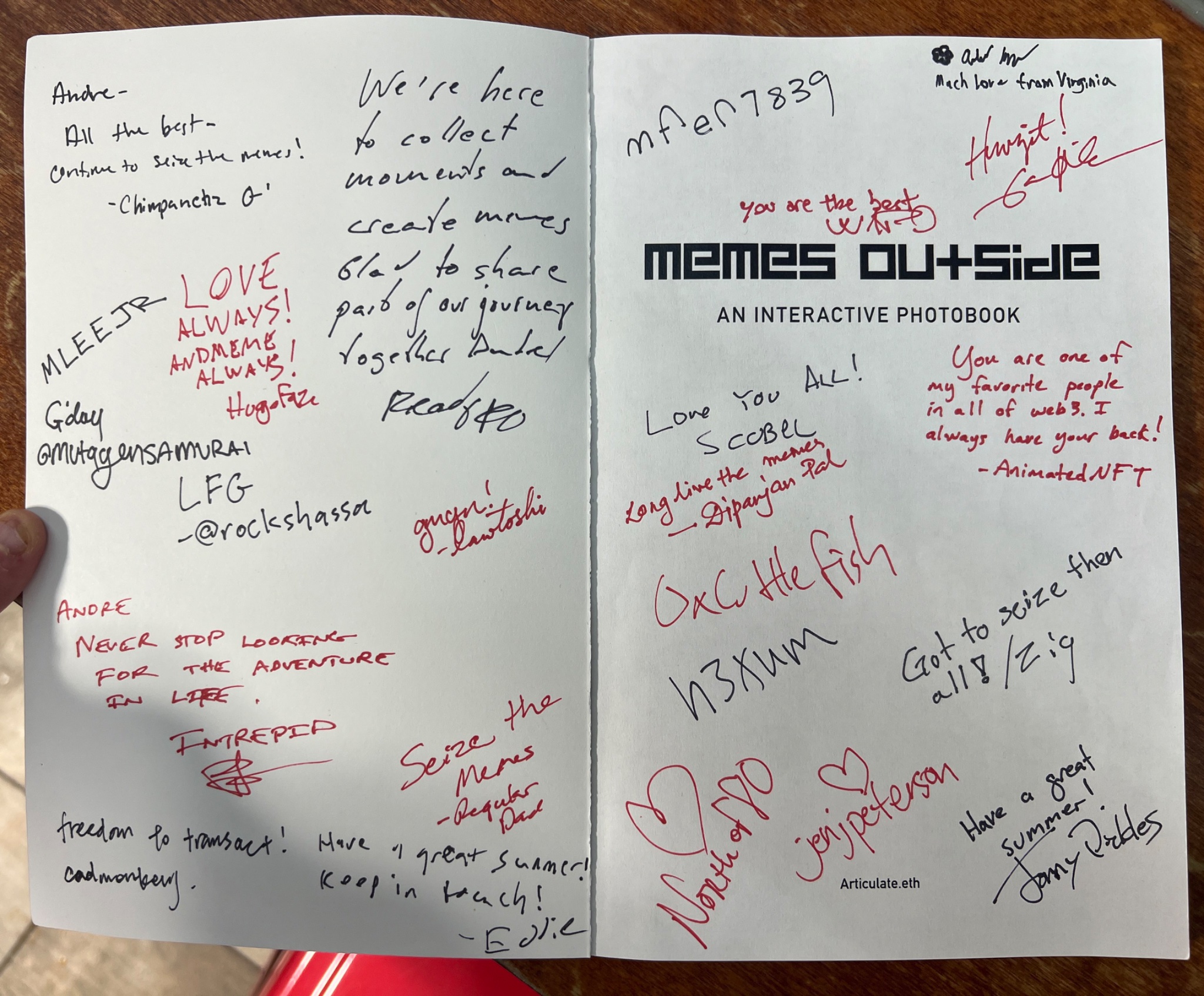
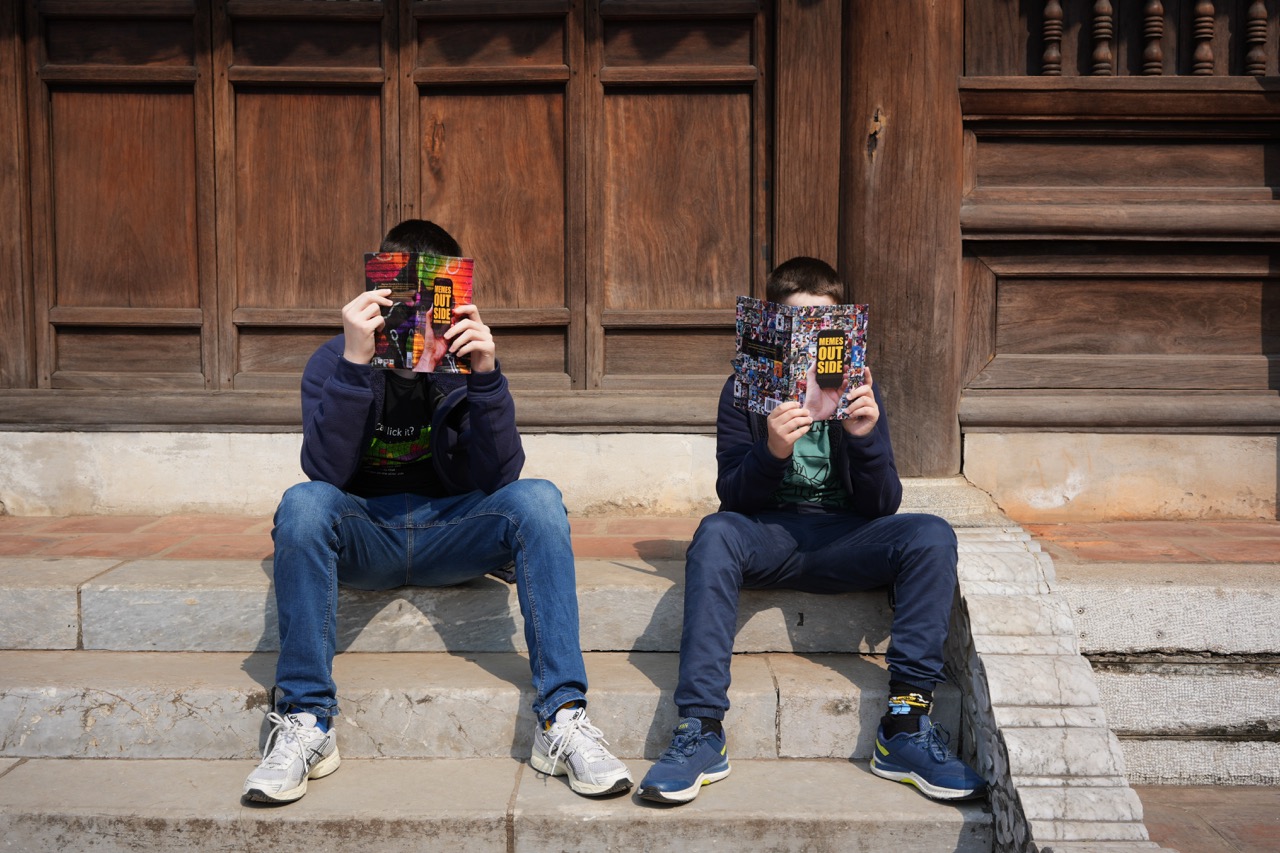
The book begins with an invitation to damage it. When you do, you are doing to the book what the practice has always done to the art: taking something that exists on the blockchain and carrying it back into the physical world, where it can be worn and used and loved and lost.
The Articulate Archive sits at the other end of the same argument. Its logic is that CC0 has already solved distribution — anyone can reproduce the image, and many do. What is now genuinely scarce is the artist's hand: the signature, the serial number, the physical certificate that links this specific print to the specific token.
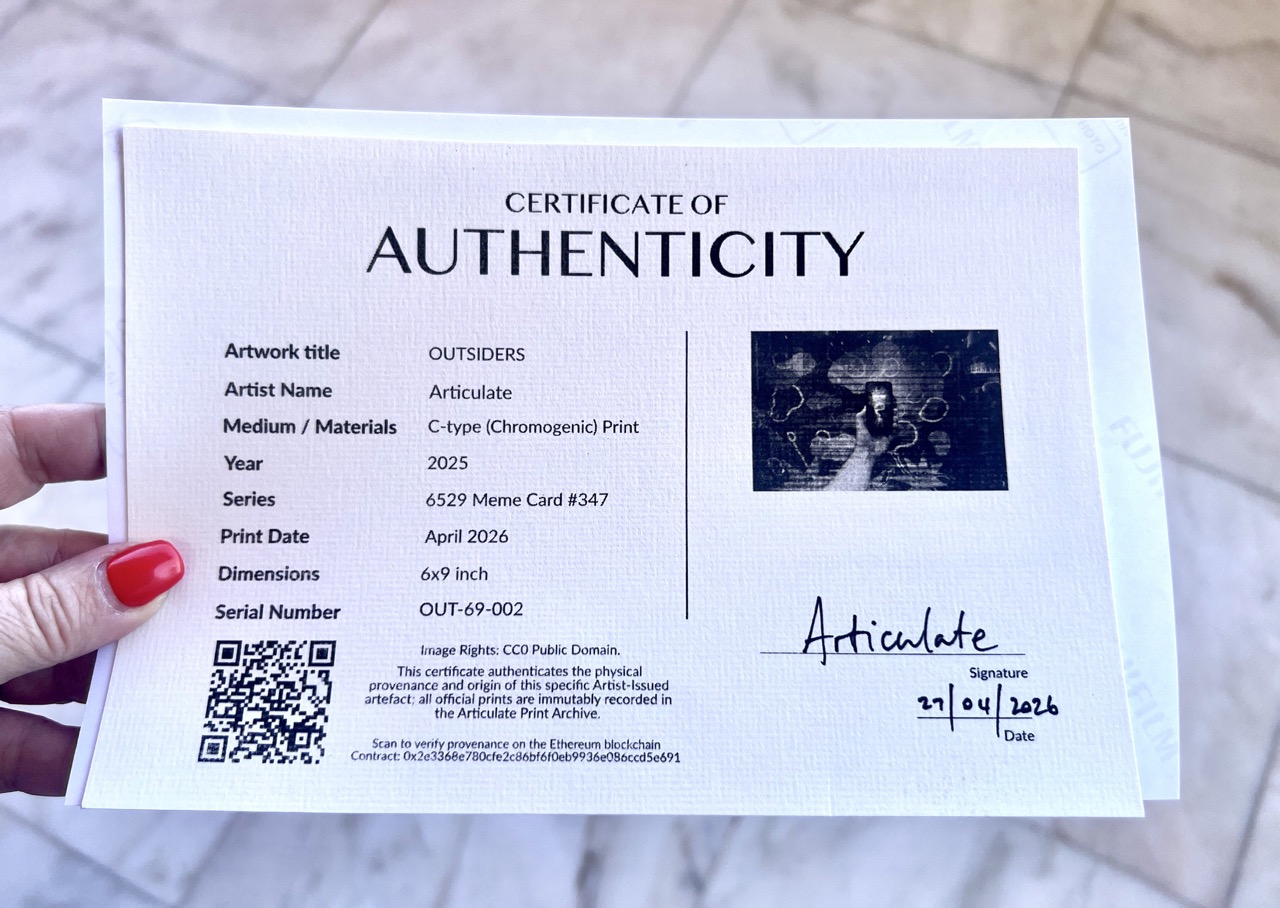
The book says the work wants to travel freely. The Archive says only one person made the original, and that fact is now permanent. Same root. Opposite directions. CC0 as distribution on one side, CC0 as proof of authorship on the other.
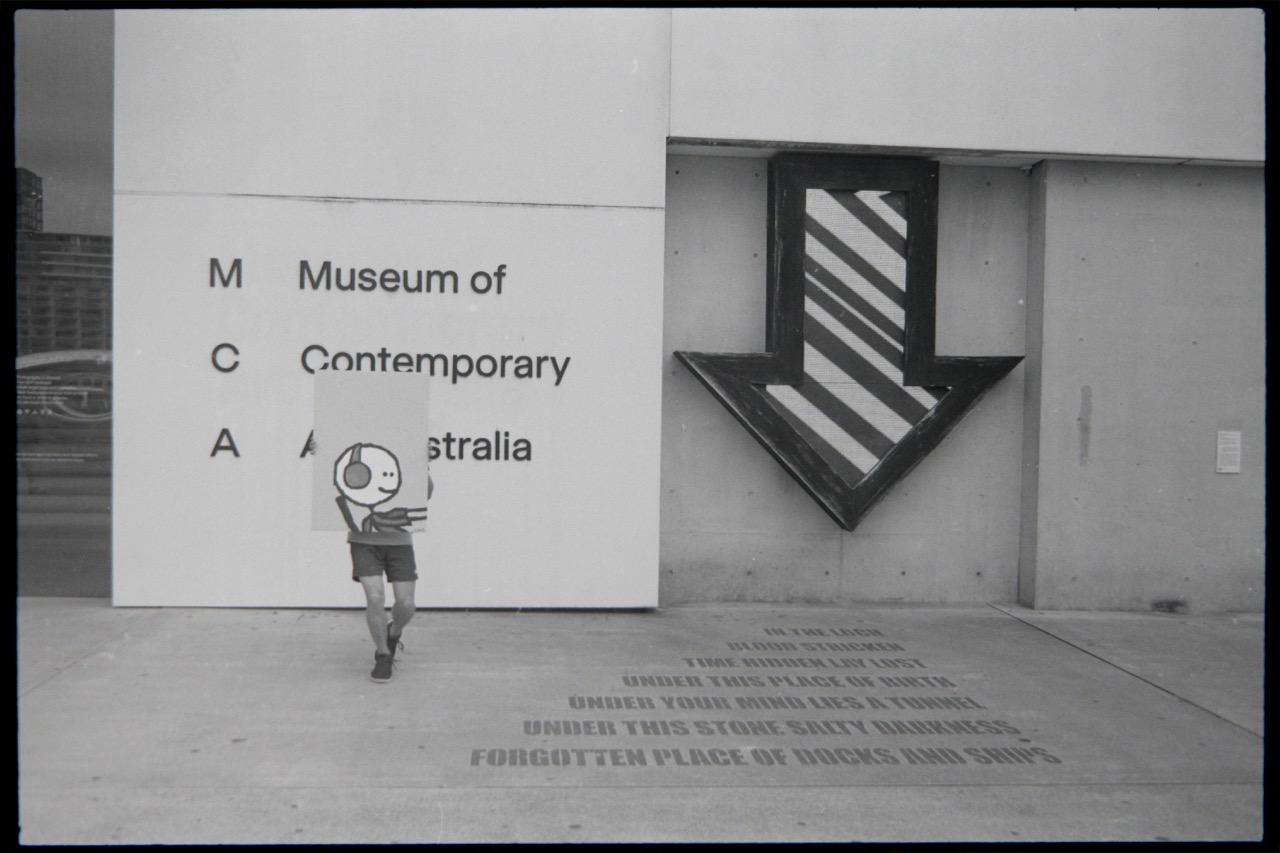
There is a line that runs from Josephson's ship postcard held against a horizon, to Alex Bartsch's covers, to Ai Weiwei's raised finger, to a phone held in Newtown. It is not a straight line but it is a continuous one.
What blockchain technology adds to this lineage is not aesthetic. It is structural. The provenance of Josephson's print is established by attribution, by institutional collection, by the slow consensus of the art world. The provenance of a Memes Outside image is established by the ledger — immutable, public, permanent. The wall forgets. The blockchain remembers. Somewhere in the space between those two facts is where the work lives, and where it will continue to live long after the street art has been painted over and the phones have been replaced and the hands have, eventually, let go.
What began as a question asked in public — can you sell analog photographs on a blockchain? — has become a body of work that spans multiple chains, multiple contracts, a published book in a national library, an international community, and a growing infrastructure for authenticating physical objects on-chain. The work is not finished. The OUTSIDERS community continues to grow. The prints continue to travel. The ideas continue to find new forms.
Memes Outside proposed that blockchain technology is most interesting not as a financial instrument but as a tool for expanding access, provoking questions, and carrying permanent digital objects back into the offline world. That assertion is not unique. But the practice of taking it outside — into weather, into hands, into the streets where people actually live — is.
![my[th] #13 — a rainbow card in water](https://pub-8d893729b90c4930a50d438e035c09b9.r2.dev/chapter-2/wmmg/wmmg-myth-13.jpg)